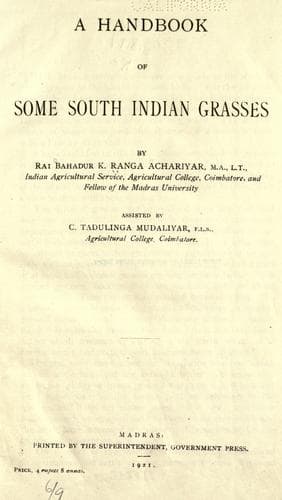
A Handbook of Some South Indian GrassesRangachari, K.
Science
A Handbook of Some South Indian Grasses
Rangachari, K.
Grasses -- India, South; Plants -- India, South
1 and 2. Spikelets; 3, 4 and 5, the first, second and the third glume,
respectively; 6. ovary, stamens and lodicules.]
There are three _glumes_. The _first_ and the _second glumes_ are empty,
narrow-linear, purple, scabrid, 1-nerved and awned; awns are capillary,
varying in length from 1/3 to 1/2 inch. The _third glume_ is very minute
with very small palea. There are three _stamens_ and two small
_lodicules_. _Styles_ are somewhat shorter. The grain is long and
cylindric.
This grass grows in open waste places and in dry fields all over the
Presidency.
_Distribution._--Throughout India.
CHAPTER VIII.
TRIBE IV--ANDROPOGONEAE.
Andropogoneae is a very large tribe with about thirty genera. It is very
well represented in South India and some genera are of very wide
distribution.
The spikelets are usually arranged in pairs at each joint, one sessile
and the other stalked. The spikelets may all be similar as in Imperata
or they may be different as in Ischaemum and Andropogon. There may be
only one flower in the spikelet as in Eremochloa and Saccharum or two as
in Ischaemum and Apocopis. In the genera Polytoca and Coix the spikelets
are unisexual and the male and female spikelets are found in the same
inflorescence, the female being below and the male being continuous with
it. The spikelet nearly always consists of four glumes, the first or the
first and the second being firmer and coriaceous or chartaceous. The
flowering glumes are always shorter than the empty glumes, and are
hyaline. The fourth glume is often awned or reduced to an awn.
The main rachis of the inflorescence is usually jointed at the base. In
addition to this the rachis may be jointed all along its length, so as
to become separated into distinct joints when mature as in Rottboellia,
Saccharum and Andropogon, or it may be continuous as in Imperata. The
pedicels of spikelets and the lower portions of the rachilla of the
spikelets may have long hairs.
Sub. Tribe 1. =Maydeae.=
The spikelets are all unisexual, spicate, the male
and female spikelets are dissimilar, and are on the
same or on different spikes.
Fruiting spikelets enclosed in a stony nut-like
polished bract 16. Coix.
Fruiting spikelets with the first glume
forming a crustaceous nut-like envelope
to other glumes and grain 17. Polytoca.
Sub. Tribe 2. =Sacchareae.=
The spikelets are all similar, in compound racemes
or panicles; the first glume not sunk in the
hollow of the rachis. Spikelets are 1-flowered.
Rachis not fragile; spikelets in cylindrical
silvery thyrsus 18. Imperata.
Rachis fragile; spikelets in open very much
branched silky panicles 19. Saccharum.
Sub. Tribe 3. =Ischemeae.=
Spikelets many, dissimilar, in solitary, digitate
or fascicled racemes or spikes; first glume not
sunk in the hollow of the rachis.
Public-domain text, read in full here on John Shaqi.
Reviews
Reviews
No reviews yet
Be the first to share your thoughts on this work.
Elsewhere in the archive
Join the Discussion
Join the discussion
Sign in to leave a comment or review.
Sign InorCreate an account