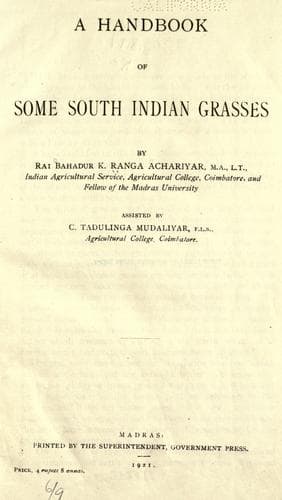
A Handbook of Some South Indian GrassesRangachari, K.
Science
A Handbook of Some South Indian Grasses
Rangachari, K.
Grasses -- India, South; Plants -- India, South
The _male spikelets_ are solitary, or binate and then one sessile and
one pedicelled, 2-flowered, reaching 3/8 inch in length and consist of
four _glumes_ each. The _first glume_ is concave, ovate, acute,
pubescent, herbaceous, many-nerved and with a narrow membranous margin
on one side only in the pedicelled and solitary spikelets and on both
sides in the sessile spikelets. The _second glume_ is narrower, dorsally
compressed, ovate, acuminate, 5- to 9-nerved, laterally compressed and
with a narrow wing to the keel near the apex in sessile spikelets and
dorsally compressed without the keel in the pedicelled and solitary
spikelets. The _third glume_ is membranous, oblong, acuminate, 3- to
5-nerved, with three stamens and paleate; the _palea_ is hyaline,
broadly linear. The _fourth glume_ is very slender, linear, hyaline,
with or without stamens, paleate; _palea_ is flat, narrowly linear.
_Lodicules_ are present and they are small. The _anthers_ in the third
glume are larger than those in the fourth glume.
The _female spikelet_ is oblong, 1/6 inch long, 1-flowered and with four
_glumes_. The _first glume_ is thickly coriaceous, white, shining,
closely embracing the rachis and the other glumes entire at the tip. The
_second glume_ is quadrately oblong, many-nerved. The _third glume_ is
oblong, narrower than the second, 3- to 5-nerved paleate, empty. The
_palea_ of the third glume is narrow, truncate. The _fourth glume_ is
narrow, truncate, 3-nerved, paleate; the _palea_ is truncate and wrapped
round the ovary. _Styles_ are long and stigmas slender. _Lodicules_ are
not present. The grain is fusiform, terete and within the nut-like
polished hardened glume.
_Distribution._--In damp situations all over India.
18. Imperata, _Cyril._
These are erect perennial grasses. The inflorescence is a spike-like
panicle, with very short filiform inarticulate branches and rachises.
Spikelets are binate, 1-flowered, all alike, both pedicelled, articulate
at the base and hidden by the very long silky hairs arising from a small
callus and from the glumes. There are four glumes. The first two glumes
are membranous, lanceolate, and subequal. The third glume is shorter and
smaller, hyaline. The fourth glume is still smaller and hyaline. Stamens
are two, rarely one. Lodicules are not found. Styles connate below, with
stigmas very long, narrow and exserted at the top of the spikelets.
Grain is small and oblong.
=Imperata arundinacea, _Cyril._=
This is an erect perennial grass with creeping, stoloniferous
root-stocks, with aerial stems varying from 6 inches to 3 feet.
The _leaf-sheath_ is loose and glabrous. The _ligule_ consists of long
soft hairs. The _nodes_ are naked or bearded.
The _leaf-blade_ is linear, flat, tapering from about the middle towards
the top, finely acuminate, and also narrowing towards the base into the
stout midrib, margins with fine long hairs at the base, 6 to 18 inches
by 1/10 to 1/3 inch, scabrous above and smooth beneath.
Public-domain text, read in full here on John Shaqi.
Reviews
Reviews
No reviews yet
Be the first to share your thoughts on this work.
Elsewhere in the archive
Join the Discussion
Join the discussion
Sign in to leave a comment or review.
Sign InorCreate an account