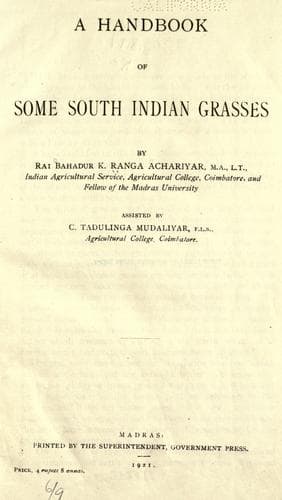
A Handbook of Some South Indian GrassesRangachari, K.
Science
A Handbook of Some South Indian Grasses
Rangachari, K.
Grasses -- India, South; Plants -- India, South
The _spikelets_ are in pairs, one-sessile and one-pedicelled. The
_sessile spikelets_ are pale-green, linear-oblong, acuminate with a
shortly bearded callus, 1/4 to 3/8 of an inch long. There are four
glumes in a spikelet. The _first glume_ is chartaceous,
oblong-lanceolate, acuminate, 2-toothed with the teeth ending in two
short awns, densely ciliated at the apex on one side, conspicuously 6-
(rarely) 7-nerved, the two lateral being very strong and running into
the apical teeth and the intermediate four nerves being shorter and not
running up to the apex, and on the dorsal surface there is a depression,
where it is membranous and the nerves on its sides sometimes
anastomosing at the upper third of the glume. The _second_ _glume_ is
shorter than the first, chartaceous to a certain extent,
ovate-lanceolate, acuminate, concave, terminating in a fine scabrid awn,
1/2 inch long, with margins ciliate from above the middle to the apex,
and with a narrow ciliated wing on the keel at the apex running up to
the base of the awn, 3-nerved. The _third glume_ is lanceolate,
acuminate, hyaline, nerveless, ciliate, with a linear obtuse _palea_
enclosing three stamens and two _lodicules_. The _fourth glume_ is
hyaline, membranous, deeply split at the apex into two prominent lobes
and with an awn in the depression 1/2 inch long, the _palea_ is linear
oblong and contains either the ovary alone or both the _stamens_ and the
_ovary_.
The _pedicelled spikelets_ are also as long as the sessile, more
conspicuous than the sessile and consist of four glumes, but are not
awned. The _first glume_ is lanceolate or oblong-lanceolate,
chartaceous, with seven strong nerves, very prominent at the back and
the mid nerve being most conspicuous, with scabrid keels and closely
finely ciliated and folded margins, finely biaristate at the apex. The
_second glume_ is lanceolate, finely acuminate, sub-chartaceous, with
the margins ciliate from about two-third its length from the apex,
3-nerved, the mid nerve alone being prominent. The _third glume_ is
hyaline, nerveless, lanceolate, ciliate in the margin, paleate with 3
stamens or empty. The _fourth glume_ is shorter than the third, hyaline,
narrow lanceolate, not awned, ciliate or not at the margin, paleate and
with three stamens and two _lodicules_.
This grass produces a large amount of leaves in good soils and it is
liked very much by cattle. It is capable of standing a long spell of dry
weather, and is valuable in this respect because it can be depended upon
when other grasses fail. It is worth conserving with other grasses. It
grows both in rich and poor soils, in open places and also in thickets.
_Distribution._--Throughout India and Ceylon.
21. Eremochloa, _Buse._
Public-domain text, read in full here on John Shaqi.
Reviews
Reviews
No reviews yet
Be the first to share your thoughts on this work.
Elsewhere in the archive
Join the Discussion
Join the discussion
Sign in to leave a comment or review.
Sign InorCreate an account