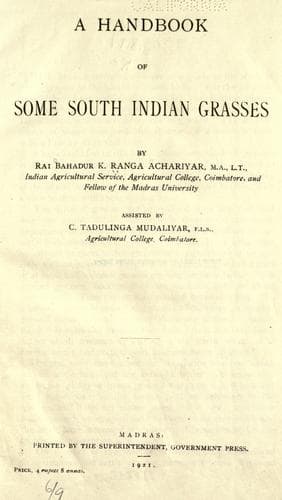
A Handbook of Some South Indian GrassesRangachari, K.
Science
A Handbook of Some South Indian Grasses
Rangachari, K.
Grasses -- India, South; Plants -- India, South
The _spikelets_ are in pairs, one sessile and one-pedicelled, both are
equal, purplish or pale. The _sessile spikelet_ consists of four glumes
and contains a complete flower and the callus is short and bearded with
long hairs. The _first glume_ is coriaceous, oblong-lanceolate, acute,
truncate or emarginate, slightly hairy, or glabrous with a deep pit
above the middle (sometimes with two or three pits also) 7- to 9-nerved
with a few long hairs below the middle and with margins infolded and
shortly ciliate. The _second glume_ is lanceolate-acuminate and finely
pointed at the tip and the point projecting slightly beyond the first
glume, 3-nerved or 3- to 5-nerved, membranous, slightly hairy or
glabrous, obscurely keeled. The _third glume_ is thin, membranous,
shorter than the second glume, linear-oblong, subobtuse or acute at the
tip and nerveless. The _fourth glume_ is the base of the awn and the
_awn_ is not twisted, bent at about the middle, 1/2 to 2/3 inch long;
there is no palea. _Anthers_ are three and yellow; _stigmas_ purple. The
grain is oblong-obovate, slightly transparent.
The _pedicelled spikelets_ are slightly narrower than the sessile,
generally not pitted (though pitted in some plants), and not awned, and
each one consists of three glumes only; the pedicel is more than half as
long as the sessile spikelets. The _first glume_ is slightly hairy,
oblong-lanceolate, acute or obtuse, ciliate at the margins, 7- to 9-, or
13-nerved, generally without pits, but occasionally with one, two or
three pits; the keels are ciliolate throughout the length. The _second
glume_ is membranous, ovate-lanceolate, acute, with incurved margins,
5-nerved. The _third glume_ is hyaline, linear-oblong, glabrous and
thinly ciliate at the tip or not with or without stamens.
This is an excellent fodder grass and it grows quickly and stands
cutting very well. Cattle eat this grass very well.
_Distribution._--This grass is found all over India in the plains or
lower elevations of hills.
=Andropogon squarrosus, _L.f._=
(_Vetiveria zizanioides._)
This is a densely tufted perennial grass with branching root-stocks and
spongy aromatic roots.
The stems are leafy, with equitant, hard, leaf-sheaths at the base,
smooth and polished, solid, 2 to 3-1/2 feet high.
The _leaf-sheaths_ are smooth, coriaceous, glabrous, keeled and
compressed. The _ligule_ is a very short membrane.
_Leaf-blades_ are narrowly linear, erect, strongly keeled and flat,
acuminate, glabrous both above and below, very much narrower than the
sheath at the base, 1 to 2 feet by 1/3 to 3/4 inch.
The _panicle_ is conical, erect with branches, fascicled, varying in
length from 4 to 12 inches. The _spikes_ consist of both sessile and
pedicelled spikelets, that are either grey, green, or purplish.
[Illustration: Fig 154.--Andropogon squarrosus.
Public-domain text, read in full here on John Shaqi.
Reviews
Reviews
No reviews yet
Be the first to share your thoughts on this work.
Elsewhere in the archive
Join the Discussion
Join the discussion
Sign in to leave a comment or review.
Sign InorCreate an account