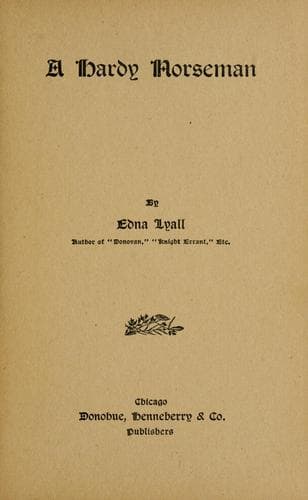
British -- Norway -- Fiction; Conduct of life -- Fiction; Norwegians -- England -- Fiction
“We are not likely to discuss the matter,” said Sigrid, and rising to
her feet she hurriedly left the room.
Upstairs she ran, choking with angry tears, her aunt’s last words
haunting her persistently and inflicting deeper wounds the more she
dwelt upon them.
“She wants me to marry him so that she may be rid of the expense of
keeping us,” thought the poor girl. “She doesn’t really care for us a
bit, for all the time she is grudging the money we cost her. But I wont
be such a bad friend to poor Torvald as to marry him because I am
miserable here. I would rather starve than do that. Oh! how I hate her
maxims about taking what you can get! Why should love and equality and a
true union lead to misery and mischief? It is the injustice of lowering
woman into a mere pleasant housekeeper that brings half the pain of the
world, it seems to me.”
But by the time Sigrid had lived through the long evening, bearing, as
best she might, the consciousness of her aunt’s disappointment and
vexation with her, another thought had begun to stir in her heart. And
when that night she went to her room her tears were no longer the tears
of anger, but of a miserable loneliness and desolation.
She looked at little Swanhild lying fast asleep, and wondered how the
refusal would affect her life.
“After all,” she thought to herself, “Swanhild would have been happier
had I accepted him. She would have had a much nicer home, and Torvald
would never have let her feel that she was a burden. He would have been
very kind to us both, and I suppose I might have made him happy—as happy
as he would ever have expected to be. And I might have been able to help
Frithiof, for we should have been rich. Perhaps I am losing this chance
of what would be best for every one else just for a fancy. Oh, what am I
to do? After all, he would have been very kind, and here they are not
really kind. He would have taken such care of me, and it would surely be
very nice to be taken care of again.”
And then she began to think of her aunt’s words, and to wonder whether
there might not be some truth in them, so that by the time the next day
had dawned she had worried herself into a state of confusion, and had
Torvald Lundgren approached her again might really have accepted him
from some puzzle-headed notion of the duty of being practical and always
considering others before yourself. Fortunately Torvald did not appear,
and later in the morning she took her perplexities to dear old Fru
Askevold, the pastor’s wife, who having worked early and late for her
ten children, now toiled for as many grandchildren, and into the bargain
was ready to be the friend of any girl who chose to seek her out. In
spite of her sixty years she had a bright, fresh-colored face, with a
look of youth about it which contrasted curiously with her snowy hair.
She was little, and plump and had a brisk, cheerful way of moving about
which somehow recalled to one—
Public-domain text, read in full here on John Shaqi.
Reviews
Reviews
No reviews yet
Be the first to share your thoughts on this work.
Elsewhere in the archive
Join the Discussion
Join the discussion
Sign in to leave a comment or review.
Sign InorCreate an account