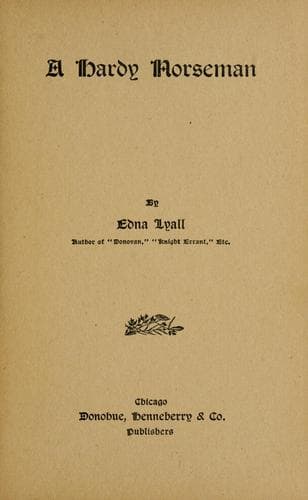
British -- Norway -- Fiction; Conduct of life -- Fiction; Norwegians -- England -- Fiction
“Six-pennyworth,” said Frithiof to the costermonger; then signing to the
child to follow, he led the way into the park, sat down on the nearest
seat, put the basket of strawberries down beside him, and glanced at his
little companion.
“There, now, sit down by me and enjoy them,” he said.
And the child needed no second bidding, but began to eat with an eager
delight which was pleasant to see. After awhile he paused, however, and
shyly pushed the basket a little nearer to his benefactor. Frithiof,
absorbed in his own thoughts, did not notice it, but presently became
conscious of a small brown hand on his sleeve, and looked round.
“Eat too,” said the child, pointing to the basket.
And Frithiof, to please him, smiled and took two or three strawberries.
“There, the rest are for you,” he said. “Do you like them?”
“Yes,” said the child emphatically; “and I like you.”
“Why do you like me?”
“I was tired, and you was kind to me, and these is real jammy!”
But after this fervent little speech, he said no more. He did not, as a
Norwegian child would have done, shake hands as a sign of gratitude, or
say in the pretty Norse way, “_Tak for maden_” (thanks for the meal);
there had never been any one to teach him the expression of the
courtesies of life, and with him they were not innate. He merely looked
at his friend with shining eyes like some animal that feels but cannot
speak its gratitude. Then before long the father reappeared, and the
little fellow with one shy nod of the head ran off, looking back
wistfully every now and then at the stranger who would be remembered by
him to the very end of his life.
The next day something happened which added the last drops to Frithiof’s
cup of misery, and made it overflow. The troubles of the past year, and
the loneliness and poverty which he had borne, had gradually broken down
his health, and there came to him now a revelation which proved the
final blow. He was dining at his usual restaurant. Too tired to eat
much, he had taken up a bit of one of the society papers which some one
had left there, and his eye fell on one of those detestable paragraphs
which pander to the very lowest tastes of the public. No actual name was
given, but every one knowing anything about her could not fail to see
that Blanche Romiaux was the woman referred to. The most revolting
insinuations, the most contemptible gossip, ended with the words, “An
interesting divorce case may soon be expected.”
Public-domain text, read in full here on John Shaqi.
Reviews
Reviews
No reviews yet
Be the first to share your thoughts on this work.
Elsewhere in the archive
Join the Discussion
Join the discussion
Sign in to leave a comment or review.
Sign InorCreate an account