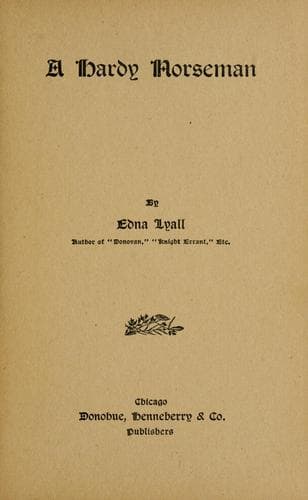
British -- Norway -- Fiction; Conduct of life -- Fiction; Norwegians -- England -- Fiction
“I can bear it no longer,” he said to himself. “I have tried to bear
this life, but it’s no use—no use.”
Yet after a while there rose within him a thought which checked the
haunting visions of failure and the longing for death. He remembered the
face which had so greatly struck him the day before, and again those
kindly words rang in his ear, “Courage! the worst will pass.”
Who was this man? What gave him his extraordinary influence? How had he
gained his insight, and sympathy, and fearless brightness? If one man
had attained to all this, why not any man? Might not life still hold for
him something that was worth having? There floated back to him the
remembrance of the last pleasurable moment he had known—it was the sight
of the child’s enjoyment of the strawberries.
At length closing-time came. He dragged himself back to Vauxhall, shut
himself into his dreary little room, pulled the table toward the open
window, and began to work at Herr Sivertsen’s translating. Night after
night he had gone on, with the dogged courage of his old Viking
ancestors, upheld by the same fierce, fighting nature which had made
them the terror of the North. But at last he was at the very end of his
strength. A violent shivering fit seized him. Work was no longer
possible; he could only stagger to the bed, with that terrible
consciousness of being utterly and hopelessly beaten, which to a man is
so hard to bear.
Oppressed by a frightful sense of loneliness, dazed by physical pain,
and tortured by the thought of Blanche’s disgrace, there was yet one
thing which gave him moments of relief—like a child he strained his eyes
to see the picture of Bergen which hung by the bedside.
Later on, when the summer twilight deepened into night, and he could no
longer make out the harbor, and the shipping, and the familiar
mountains, he buried his face in the pillow and sobbed aloud, in a
forlorn misery which, even in Paradise, must have wrung his mother’s
heart.
Roy Boniface came back from Devonshire the following day, his holiday
being shortened by a week on account of the illness of Mrs. Horner’s
uncle. As there was every reason to expect a legacy from this aged
relative, Mr. Horner insisted on going down at once to see whether they
could be of any use; and since the shop was never left without one of
the partners, poor Roy, anathematizing the whole race of the Horners,
had to come back and endure as best he might a London August and an
empty house.
Public-domain text, read in full here on John Shaqi.
Reviews
Reviews
No reviews yet
Be the first to share your thoughts on this work.
Elsewhere in the archive
Join the Discussion
Join the discussion
Sign in to leave a comment or review.
Sign InorCreate an account