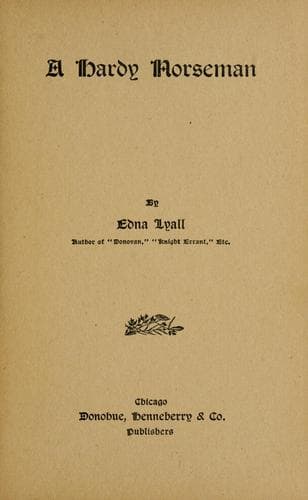
British -- Norway -- Fiction; Conduct of life -- Fiction; Norwegians -- England -- Fiction
At the first moment Sigrid had fallen in love with the sweet-natured,
motherly old lady, and now she opened all her heart to her, and they
discussed the sad cause of Frithiof’s breakdown, and talked of past days
in Norway, and of the future that lay before him, Cecil listening with
that absolute command of countenance which betokens a strong nature, and
her companions little dreaming that their words, though eagerly heard,
were like so many sword-thrusts to her. The neat brougham of the
successful tradesman might have seemed prosaic enough, and an unlikely
place in which to find any romance, but nevertheless the three occupants
with their joys and sorrows, their hopes and fears, were each living out
an absorbing life story. For every heart has its own romance, and
whether living in the fierce glare of a palace, in the whirl of society,
in a quiet London suburb, or in an East-end court, it is all the same.
The details differ, the accessories are strangely different, but the
love which is the great mainspring of life is precisely the same all the
world over.
“What makes me so miserable,” said Sigrid, “is to feel that his life is,
as it were, over, though he is so young: it has been spoiled and ruined
for him when he is but one-and-twenty.”
“But the very fact of his being so young seems to me to give hope that
brighter things are in store for him,” said Mrs. Boniface.
“I do not think so,” said Sigrid. “That girl has taken something from
him which can never come again: it does not seem to me possible that a
man can love like that twice in a lifetime.”
“Perhaps not just in that way,” said Mrs. Boniface.
“And besides,” said Sigrid, “what girl would care to take such love as
he might now be able to give? I am sure nothing would induce me to
accept any secondary love of that kind.”
She spoke as a perfectly heart-whole girl, frankly and unreservedly. And
what she said was true. She never could have been satisfied with less
than the whole; it was her nature to exact much; she could love very
devotedly, but she would jealously demand an equal devotion in return.
Now Cecil was of a wholly different type. Already love had taken
possession of her, it had stolen into her heart almost unconsciously and
had brought grave shadows into her quiet life, shadows cast by the
sorrow of another. Her notion of love was simply freedom to love and
serve; to give her this freedom there must of course be true love on the
other side, but of its kind or of its degree she would never trouble
herself to think. For already her love was so pure and deep that it
rendered her almost selfless. Sigrid’s speech troubled her for a minute
or two; if one girl could speak so, why not all girls? Was she perhaps
less truly womanly that she thought less of what was owing to herself?
Public-domain text, read in full here on John Shaqi.
Reviews
Reviews
No reviews yet
Be the first to share your thoughts on this work.
Elsewhere in the archive
Join the Discussion
Join the discussion
Sign in to leave a comment or review.
Sign InorCreate an account