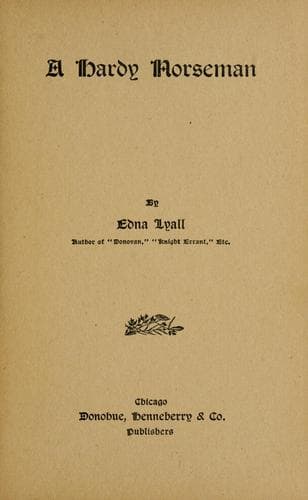
British -- Norway -- Fiction; Conduct of life -- Fiction; Norwegians -- England -- Fiction
After all, the child with her warm-hearted forgiveness, and her scanty
knowledge of facts, was perhaps a good deal nearer the truth than
Sigrid. Certainly Blanche was not the ideal of her dreams, but she was
very far from being the hopelessly depraved character that Sigrid deemed
her; she was a woman who had sinned very deeply, but she was not utterly
devoid of heart, and there were gleams of good in her to which the
Norwegian girl, in her hot indignation, was altogether blind. Sigrid was
not faultless, and as with Frithiof, so there lingered too with her a
touch of the fierce, unforgiving spirit which had governed their Viking
ancestors.
More than once that morning as she moved about her household tasks she
said under her breath—“I wish that woman were dead!—I wish she were
dead!”
“You don’t look well this morning, Mr. Falck,” said the foreman, a
cheerful, bright-eyed, good-hearted old man, who had managed to bring up
a large family on his salary, and to whom Frithiof had often applied for
advice on the subject of domestic economy. The two liked each other now
cordially, and worked well together, Foster having altogether lost the
slight prejudice he had at first felt against the foreigner.
“We were up late last night,” said Frithiof, by way of explanation. But
the old man was shrewd and quick-sighted, and happening later on to be
in Mr. Boniface’s private room, he seized the opportunity to remark:
“We shall have Mr. Falck knocking up again, sir, if I’m not mistaken: he
is looking very ill to-day.”
“I’m sorry to hear that,” said Mr. Boniface. “You were quite right to
tell me, Foster. We will see what can be done.”
And the foreman knew that there was no favoritism in this speech, for
Mr. Boniface considered the health of his employees as a matter of the
very highest importance, and being a Christian first and a tradesman
afterward, did not consider money-making to be the great object of life.
Many a time good old Foster himself had been sent down for a few days at
the seaside with his family, and it was perhaps a vivid remembrance of
the delights of West Codrington that made him add as he left the room:
“He looks to me, sir, as if he needed bracing up.”
Mr. Boniface was much of the same opinion when he noticed Frithiof later
on in the day. A thoroughly good salesman the Norwegian had always
been—clear-headed, courteous, and accurate; but now the look of effort
which he had borne for some time before his illness was clearly visible,
and Mr. Boniface seized the first chance he could get of speaking to him
alone. About five o’clock there came a lull in the tide of customers;
Darnell, the man at the opposite counter, had gone to tea, and Frithiof
had gone back to his desk to enter some songs in the order-list.
“Frithiof,” said Mr. Boniface, coming over to him and dropping the
somewhat more formal style of address which he generally used toward him
during business hours, “you have got one of your bad headaches.”
Public-domain text, read in full here on John Shaqi.
Reviews
Reviews
No reviews yet
Be the first to share your thoughts on this work.
Elsewhere in the archive
Join the Discussion
Join the discussion
Sign in to leave a comment or review.
Sign InorCreate an account