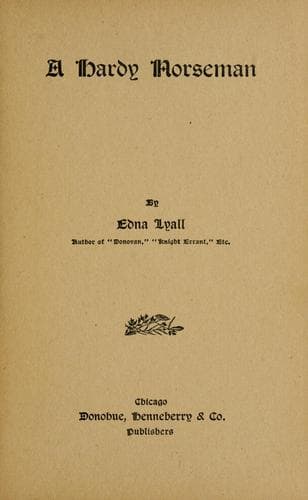
British -- Norway -- Fiction; Conduct of life -- Fiction; Norwegians -- England -- Fiction
“It was quite enough to make him ill. Such a disgraceful affair in a
house of this class. For his own sake he does well to hush it up, though
I intend to see that all proper precautions are taken; upon that, at any
rate, I insist. If I had my own way there should have been none of this
misplaced leniency. Here, William!” and he beckoned to the boy, who was
irreverently flicking the bust of Mozart with a duster.
“Yes, sir,” said William, who, being out of the trouble himself,
secretly rather enjoyed the commotion it had caused.
“Go at once to Smith, the ironmonger, and order him to send some one
round to fix a spring bell on a till. Do you understand?”
“Quite, sir,” replied William, unable to resist glancing across the
counter.
Frithiof went on arranging some music that had just arrived, but he
flushed deeply, and Mr. Horner, glad to have found a vulnerable point of
attack, did not scruple to make the most of his opportunity. Never,
surely, did ironmonger do his work so slowly! Never, surely, did an
employer give so much of his valuable time to directing exactly what was
to be done, and superintending an affair about which he knew nothing.
But the fixing of that detestable bell gave Mr. Horner a capitol excuse
for being in the shop at Frithiof’s elbow, and every word and look
conveyed such insulting suspicion of the Norwegian that honest old
Foster began to feel angry.
“Why should I mind this vulgar brute?” thought Frithiof, as he forced
himself to go on with his work with the air of quiet determination which
Mr. Horner detested. But all the same he did care, and it was the very
vulgarity of the attack that made him inwardly wince. His headache grew
worse and worse, while in maddening monotony came the sounds of piano
tuning from the inner shop, hammering and bell-ringing at the till close
by, and covert insults and innuendoes from the grating voice of James
Horner. How much an employer can do for those in his shop, how close and
cordial the relation may be, he had learnt from his intercourse with Mr.
Boniface. He now learnt the opposite truth, that no position affords
such constant opportunities for petty tyranny if the head of the firm
happens to be mean or prejudiced. The miserable hours dragged on
somehow, and at last, late in the afternoon, Foster came up to him with
a message.
“Mr. Horner wishes to speak to you,” he said; “I will take your place
here.” Then, lowering his voice cautiously, “It’s my opinion, Mr. Falck,
that he is trying to goad you into resigning, or into an impertinent
answer which would be sufficient to cause your dismissal.”
“Thank you for the warning,” said Frithiof gratefully, and a little
encouraged by the mere fact that the foreman cared enough for him to
speak in such a way, he went to the private room, determined to be on
his guard and not to let pride or anger get the better of his dignity.
Mr. Horner replied to his knock, but did not glance round as he entered
the room.
Public-domain text, read in full here on John Shaqi.
Reviews
Reviews
No reviews yet
Be the first to share your thoughts on this work.
Elsewhere in the archive
Join the Discussion
Join the discussion
Sign in to leave a comment or review.
Sign InorCreate an account