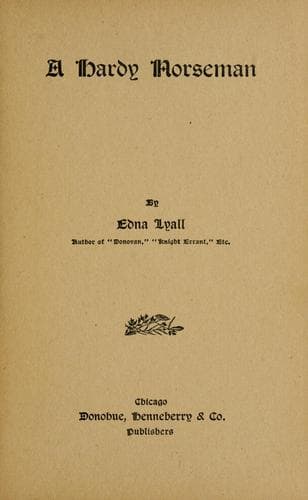
British -- Norway -- Fiction; Conduct of life -- Fiction; Norwegians -- England -- Fiction
“You know, Cecil,” said her mother, as she returned to the seat under
the verandah and began to arrange the flowers in a basket, “I have
another theory as to this affair. It happened exactly a week after that
day at the seaside when we all had such a terrible fright about Roy and
Sigrid. Frithiof had a long run in the sun, which you remember was very
hot that day; then he had all the excitement of rowing out and rescuing
them, and though at the time it seemed no strain on him at all, yet I
think it is quite possible that the shock may have brought back a slight
touch of the old trouble.”
“And yet it seemed to do him good at the time,” said Cecil. “He looked
so bright and fresh when he came back. Besides, to a man accustomed as
he once was to a very active life, the rescue was, after all, no such
great exertion.”
Mrs. Boniface sighed.
“It would grieve me to think that it was really caused by that, but if
it is so, there is all the more reason that they should clearly
understand that the affair makes no difference at all in our opinion of
him. It is just possible that it may be his meeting with Lady Romiaux
which is the cause. Sigrid told me they had accidentally come across her
again, and that it had tried him very much.”
Cecil turned away to gather some ferns from the rockery; she could not
bear to discuss that last suggestion. Later on in the afternoon it was
with a very heavy heart that she reached the model lodgings and knocked
at the door that had now become so familiar to her.
Swanhild flew to greet her with her usual warmth. It was easy to see
that the child knew nothing of the trouble hanging over the house. “What
lovely flowers! How good of you!” she cried.
But Sigrid could not speak: she only kissed her, then turned to Swanhild
and the flowers once more.
“They are beautiful,” she said. “Don’t you think we might spare some for
Mrs. Hallifield? Run and take her some, dear.”
When the child ran off she drew Cecil into their bedroom. The two girls
sat down together on the bed, but Sigrid, usually the one to do most of
the talking, was silent and dejected. Cecil saw at once that she must
take the initiative.
“I have been longing to come and see you,” she said. “But yesterday was
so filled up. Father and mother are so sorry for all this trouble, and
are very much vexed that Mr. Horner has behaved badly about it.”
“They are very kind,” said Sigrid wearily. “Of course most employers
would have prosecuted Frithiof, or, at any rate, discharged him.”
“But, Sigrid, what can be the explanation of it? Oh, surely we can
manage to find out somehow! Who can have put the note in his pocket?”
“What!” cried Sigrid. “Do not you, too, hold Mr. Boniface’s opinion, and
think that he himself did it unintentionally?”
“I!” cried Cecil passionately. “Never! never! I am quite sure he had
nothing whatever to do with it.”
Sigrid flung her arms round her.
“Oh, how I love you for saying that!” she exclaimed.
Public-domain text, read in full here on John Shaqi.
Reviews
Reviews
No reviews yet
Be the first to share your thoughts on this work.
Elsewhere in the archive
Join the Discussion
Join the discussion
Sign in to leave a comment or review.
Sign InorCreate an account