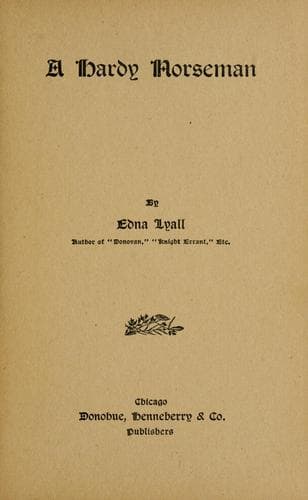
British -- Norway -- Fiction; Conduct of life -- Fiction; Norwegians -- England -- Fiction
“How did the lady’s name happen to be in the paper?”
“Sigrid said it was because she had broken her promise to her husband;
it was written in very big letters—‘The Romiaux Divorce Case,’” said
Swanhild.
Charles Osmond started. For some minutes he was quite silent. Then, his
eyes falling once more on the wistful little face that was trying so
hard to read his thoughts, he smiled very kindly.
“Do you know where Lady Romiaux is living?” he asked. But Swanhild had
no idea. “Well, never mind; I think I can easily find out, for I happen
to know one of the barristers who was defending her. You had better, I
think, sit down at my desk and write her just a few lines, asking her to
release you from your promise; I will take it to her at once, and if you
like you can wait here till I bring back the answer.”
“But that will be giving you so much trouble,” said Swanhild, “and on
Sunday, too, when you have so much to do.”
He took out his watch.
“I shall have plenty of time,” he said, “and if I am fortunate enough to
find Lady Romiaux, you shall soon get rid of your trouble.”
CHAPTER XXXIII.
Having established Swanhild at the writing-table, Charles Osmond left
her for a few minutes and went up to the drawing-room; it was one of
those comfortable, old-fashioned rooms which one seldom sees now, and
resting on the sofa was one of those old-world ladies whose sweet
graciousness has such a charm to the more restless end of the nineteenth
century. No less than four generations were represented in the room, for
by the fire sat Charles Osmond’s daughter-in-law, and on her knee was
her baby son—the delight of the whole house.
“Erica,” he said, coming toward the hearth, “strangely enough the very
opportunity I wanted has come. I have been asked to see Lady Romiaux on
a matter connected with some one who once knew her, so you see it is
possible that after all your wish may come true, and I may be of some
use to her.”
Erica looked up eagerly, her face which in repose was sad, brightened
wonderfully.
“How glad I am, father! You know Donovan always said there was so much
that was really good in her, if only some one could draw it out.”
“How did the case end?” asked Mrs. Osmond.
“It ended in a disagreement of the jury,” replied her son, “Why, I can’t
understand, for the evidence was utterly against her, according to
Ferguson. I am just going round to see him now, and find out her address
from him, and in the mean time there’s a dear little Norwegian girl in
my study, who will wait till I bring back an answer. Would you like her
to come up here?”
“Yes, yes,” said Erica, “by all means let us have her if she can talk
English. Rae is waking up, you see, and we will come down and fetch
her.”
Public-domain text, read in full here on John Shaqi.
Reviews
Reviews
No reviews yet
Be the first to share your thoughts on this work.
Elsewhere in the archive
Join the Discussion
Join the discussion
Sign in to leave a comment or review.
Sign InorCreate an account