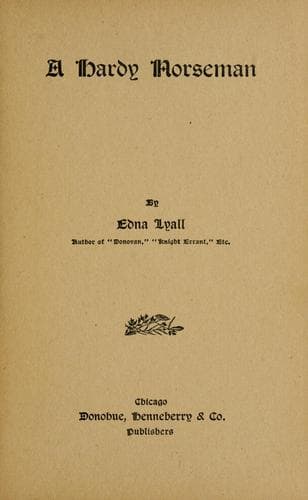
British -- Norway -- Fiction; Conduct of life -- Fiction; Norwegians -- England -- Fiction
The two years had not greatly altered him, but he seemed more full of
life and vigor than before, and success and hope had entirely banished
the look of conflict which for so long had been plainly visible in his
face. Sigrid felt proud of him as she glanced round; there was something
in his mere physical strength which always appealed to her.
“We were just talking about you,” she said, “and wondering when you
would be ready to play.”
“After that remark of yours which I overheard I almost think I shall
have to eschew tennis,” he said, laughing. “Why should I give a whole
hour to it when Herr Sivertsen is impatiently waiting for the next
installment?”
“Herr Sivertsen is insatiable,” said Sigrid, taking off her
gardening-gloves. “And I’m not going to allow you to return to your old
bad ways; as long as you live with me you will have to be something more
than a working drudge.”
“Since Sigrid has begun baby’s education,” said Frithiof, turning
laughingly to Cecil, “we notice that she has become very dictatorial to
the rest of us.”
“You shouldn’t make stage asides in such a loud voice,” said Sigrid,
pretending to box his ears. “I am going to meet Roy and to fetch the
racquets, and you take him into the garden, Cecil, and make him behave
properly.”
“Are you really so specially busy just now?” asked Cecil, as he opened
the little gate and joined her; “or was it only your fun?”
“No, it was grim earnest,” he replied. “For since Herr Sivertsen has
been so infirm I have had most of his work to do. But it is well-paid
work, and a very great help toward the debt fund. In ten years’ time I
may be free.”
“You will really have paid off everything?”
“I quite hope to be able to do so.”
“It will be a great work done,” she said thoughtfully. “But when it is
all finished, I wonder whether you will not feel a little like the men
who work all their lives to make a certain amount and then retire, and
can’t think what to do with themselves?”
“I hope not,” said Frithiof; “but I own that there is a chance of it.
You see, the actual work in itself is hateful to me. Never, I should
think, was there any one who so loathed indoor work of all kinds,
specially desk work. Yet I have learned to take real interest in the
business, and that will remain and still be my duty when the debts are
cleared off. It is a shocking confession, but I own that when Herr
Sivertsen’s work is no longer a necessity it will be an immense relief
to me, and I doubt if I shall ever open that sort of book again.”
“It must be terrible drudgery,” said Cecil, “since you can’t really like
it.”
“Herr Sivertsen has given me up as a hopeless case; he has long ago
ceased to talk about Culture with a capital C to it; he no longer
expects me to take any interest in the question whether earth-worms do
or do not show any sensitiveness to sound when placed on a grand piano.
I told him that the bare idea is enough to make any one in the trade
shudder.”
Public-domain text, read in full here on John Shaqi.
Reviews
Reviews
No reviews yet
Be the first to share your thoughts on this work.
Elsewhere in the archive
Join the Discussion
Join the discussion
Sign in to leave a comment or review.
Sign InorCreate an account