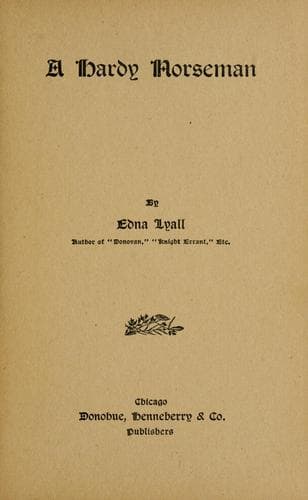
British -- Norway -- Fiction; Conduct of life -- Fiction; Norwegians -- England -- Fiction
When the will was read it affirmed that Herr Sivertsen, who had no
relations living, had indeed left his property to Frithiof. The will was
terse and eccentric in the extreme, and seemed like one of the old man’s
own speeches, ending with the familiar words, “for he is one of the few
honest and hard-working men in a despicable generation.”
Naturally there was only one way to which Frithiof could think of
putting his legacy. Every penny of it went straight to his debt-fund.
Mr. Horner heard of it and groaned. “What!” he exclaimed, “pay away the
principal; hand over thousands of pounds in payment of debts that are
not even his own—debts that don’t affect his name! He ought to put the
money into this business, Boniface; it would only be a fitting way of
showing you his gratitude.”
“He put into the business what I value far more,” said Mr. Boniface. “He
put into it his honest Norwegian heart, and this legacy will save him
many years of hard, weary work and anxiety.”
When summer came it was arranged that they should go to Norway, and
Frithiof went about his work with such an air of relief and contentment,
that had it not been for one hidden anxiety Sigrid’s happiness would
have been complete.
Her marriage had been so extremely happy that she was less than ever
satisfied with the prospect that seemed to lie before Cecil. The secret
which she had found out at the time of Frithiof’s disgrace weighed upon
her now a good deal; she almost wished that Roy would guess it; but no
one else seemed to have any suspicion of it at all, and Sigrid of course
could not speak, partly because she was Frithiof’s sister, partly
because she had a strong feeling that to allude to that matter would be
to betray Cecil unfairly. Had she been a matchmaker she might have done
endless harm; had she been a reckless talker she would probably have
defeated her own ends; but happily she was neither, and though at times
she longed to give Frithiof a good shaking, when she saw him entirely
absorbed in his work and blind to all else, she managed to keep her own
counsel, and to await, though somewhat impatiently, whatever time should
bring. One evening it chanced that the brother and sister were alone for
a few minutes during the intervals of an amateur concert, which Cecil
had been asked to get up at Whitechapel.
“How do you think it has gone off?” said Sigrid, as he sat down beside
her in the little inner room.
“Capitally; Cecil ought to be congratulated,” he replied. “I am glad she
has had it on hand, for it must have taken her thoughts off the
children.”
“Yes,” said Sigrid; “anything that does that is worth something.”
“Yet she seems to me to have plenty of interests,” said Frithiof. “She
is never idle; she is a great reader.”
“Do you think books would ever satisfy a woman like Cecil?” exclaimed
Sigrid, with a touch of scorn in her voice.
Public-domain text, read in full here on John Shaqi.
Reviews
Reviews
No reviews yet
Be the first to share your thoughts on this work.
Elsewhere in the archive
Join the Discussion
Join the discussion
Sign in to leave a comment or review.
Sign InorCreate an account