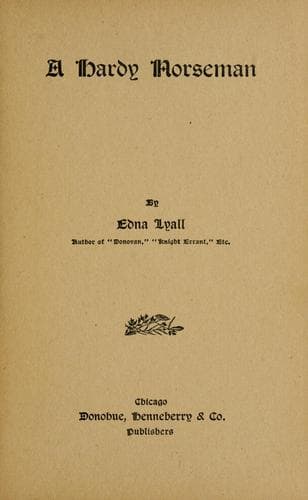
British -- Norway -- Fiction; Conduct of life -- Fiction; Norwegians -- England -- Fiction
“It was superstition,” she said thoughtfully. “And yet, perhaps, the
sight of the cross and the drinking of the water at least helped them to
new thoughts of suffering and of life. Who knows, perhaps some of them
went away able to glory in their infirmities?”
He did not speak for some minutes, but stood lost in the train of
thought suggested to him by her words. The sadness gradually died out of
his face, and she quite understood that it was with no trace of
superstition, but merely as a sign of gratitude for a thought which had
helped him, that he took two little straight twigs, stooped to drink
from St. Olafskilde, and then set up his cross among the others in the
mossy wall. After that they clambered down over the bowlders into the
sandy road once more, and climbed the steep hill leisurely, planning
many things for the future—the rooms in Rowan Tree House, the little
wooden cottage that they meant to build at Gödesund, three hours by
water from Bergen, on a tiny island, which might be bought at a trifling
cost; the bright holiday weeks that they would spend there; the work
they might share; the efforts they might make together in their London
life.
But the sharp contrast between this pictured future and the actual past
could hardly fail to strike one of Frithiof’s temperament; it was the
thought of this which prompted him to speak as they paused to rest on
the wooded heights above Hillestad.
“I almost wonder,” he said, “that you have courage to marry such an
ill-starred fellow as I have always proved to be. You are very brave to
take the risk.”
She answered him only with her eyes.
“So,” he said with a smile, “you think, perhaps, after all the troubles
there must be a good time coming?”
“That may very well be,” she replied, “but now that we belong to each
other outer things matter little.”
“Do you remember the lines about Norway in the Princess?” he said. “Your
love has made them true for me.”
“Say them now,” she said; “I have forgotten,”
And, looking out over the ruddy sky where, in this night hour, the glow
of sunset mingled with the glow of dawn, he quoted the words:
“I was one
To whom the touch of all mischance but came
As night to him that sitting on a hill
Sees the midsummer, midnight, Norway sun
Set into sunrise.”
Public-domain text, read in full here on John Shaqi.
Reviews
Reviews
No reviews yet
Be the first to share your thoughts on this work.
Elsewhere in the archive
Join the Discussion
Join the discussion
Sign in to leave a comment or review.
Sign InorCreate an account