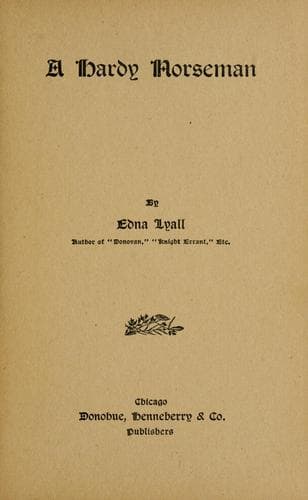
British -- Norway -- Fiction; Conduct of life -- Fiction; Norwegians -- England -- Fiction
Her quiet life with the vague feeling of something wanting in it had
indeed been changed by the Norwegian holiday. Now, for the first time,
she realized that her uneventful girlhood was over; she had become a
woman, and, woman-like, she bravely accepted the pain which love had
brought into her life, and looked sadly, perhaps, yet unshrinkingly into
the future, where it was little likely that anything but grief and
anxiety awaited her. For she loved a man who was absolutely indifferent
to her, and her love had given her clear insight. She saw that he was a
man whose faith in love, both human and divine, had been crushed out of
him by a great wrong; a man whose whole nature had deteriorated and
would continue to deteriorate, unless some unforeseen thing should
interfere to change his whole view of life.
But the scalding tears which rose to her eyes were not tears of
self-pity; they were tears of sorrow for Frithiof, of disappointment
about his ruined life, of a sad humility as she thought to herself: “Oh!
if only I were fit to help him! If only!”
Meanwhile in the study a very matter-of-fact conversation was being
held.
“What I want to find out,” said Mr. Boniface, “is whether you are really
in earnest in what you say about work. There are thousands of young men
saying exactly the same thing, but when you take the trouble to go into
their complaint you find that the real cry is not ‘Give me work by which
I can get an honest living!’ but ‘Give me work that does not clash with
my tastes—work that I thoroughly like.’”
“I have no particular tastes,” said Frithiof coldly. “The sort of work
is quite indifferent to me as long as it will bring in money.”
“You are really willing to begin at the bottom of the ladder and work
your way up? You are not above taking a step which would place you much
lower in the social scale.”
“A fellow living on the charity of a relation who grudges every
farthing, as taking something away from his own children, is not likely
to trouble much about the social scale,” said Frithiof bitterly.
“Very well. Then I will, at any rate, suggest my plan for you, and see
what you think of it. If you care to accept it until something better
turns up, I can give you a situation in my house of business. Your
salary to begin with would be but small; the man who leaves me next
Monday has had only five and-twenty shillings a week, and I could not,
without unfair favoritism, give you more at first. But every man has a
chance of rising, and I am quite sure that you, with your advantages,
would do so. You understand that, as I said, it is mere work that I am
offering you. Doubtless standing behind a counter will not be very
congenial work to one brought up as you have been; but you might do
infinitely worse, and I can at least promise you that you will be
treated as a man—not, as in many places you would find it, as a mere
‘hand.’”
Public-domain text, read in full here on John Shaqi.
Reviews
Reviews
No reviews yet
Be the first to share your thoughts on this work.
Elsewhere in the archive
Join the Discussion
Join the discussion
Sign in to leave a comment or review.
Sign InorCreate an account