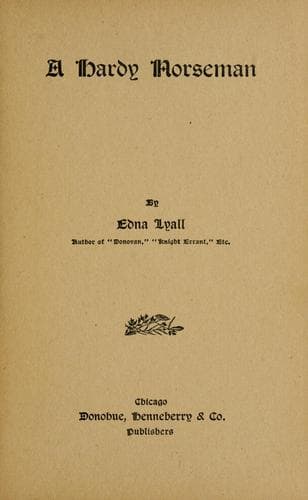
British -- Norway -- Fiction; Conduct of life -- Fiction; Norwegians -- England -- Fiction
“The trouble generally is to find bears to shoot.”
“Yes, but Cecil did see where a bear had made its bed up on Munkeggen,
didn’t you, Cecil?”
“Yes, yes, and you shall go with me some day,” she said, hurrying the
little fellow off because she thought the allusion to Munkeggen would
perhaps hurt Frithiof.
Roy was on the point of taking up the thread of conversation again about
Norway, but she promptly intervened.
“I don’t know how we shall cure Lance of dancing with rage like that; we
have the same scene every night.”
“You went the right way to work just now,” said Mr. Boniface. “You made
him understand why his own wishes must be thwarted; and you see he was
quite willing to believe what you said. You had a living proof of what
you were arguing—he did what he had once disliked because he saw that it
was the road to something higher, and better, and more really desirable
than his play down here. In time he will have a sort of respectful
liking for the road which once he hated.”
“The only drawback is,” said Frithiof, rather bitterly, “that he may
follow the road, and it may not lead him to what he expects; he may go
to bed like an angel, and yet, in spite of that, lose his health, or
grow up without a chance of taking you to Norway or shooting bears.”
“Well, what then?” said Cecil quietly. “It will have led him on in the
right direction, and if he is disappointed of just those particular
things, why, he must look further and higher.”
Frithiof thought of his dream and was silent.
“I’m going to make tea, Roy,” said Mrs. Boniface, laying down her
netting, “and you had better show Herr Falck his room. I hope you’ll
often come and spend Sunday with us,” she added, with a kindly glance at
the Norwegian.
In the evening they had music. Roy and Cecil both sung well; their
voices were not at all out of the common, but no pains had been spared
on their training, and Frithiof liked the comfortable, informal way in
which they sung one thing after another, treating him entirely as one of
the family.
“And now it is your turn,” said Cecil, after awhile. “Father, where is
that Amati that somebody sent you on approval? Perhaps Herr Falck would
try it?”
“Oh, do you play the violin?” said Mr. Boniface; “that is capital.
You’ll find it in my study cupboard, Cecil; stay, here’s the key.”
Frithiof protested that he was utterly out of practice, that it was
weeks since he had touched his violin, which had been left behind in
Norway; but when he actually saw the Amati he couldn’t resist it, and it
ended in his playing to Cecil’s accompaniment for the rest of the
evening.
To Cecil the hours seemed to fly, and Mrs. Boniface, after a preliminary
round of tidying up the room, came and stood by her, watching her bright
face with motherly contentment.
“Prayer time, darling,” she said, as the sonata came to an end; “and
since it’s Saturday night we mustn’t be late.”
Public-domain text, read in full here on John Shaqi.
Reviews
Reviews
No reviews yet
Be the first to share your thoughts on this work.
Elsewhere in the archive
Join the Discussion
Join the discussion
Sign in to leave a comment or review.
Sign InorCreate an account