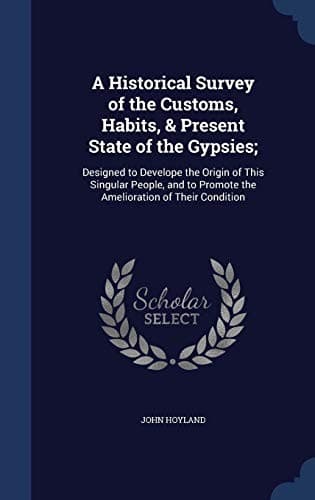
A Historical Survey of the Customs, Habits, & Present State of the GypsiesHoyland, John
History
A Historical Survey of the Customs, Habits, & Present State of the Gypsies
Hoyland, John
Romanies
We have seen that Gypsies always choose their place of residence near
some village, or city, very seldom within them; even though there may not
be any order to prevent it, as is the case in Moldavia, Wallachia, and
all parts of Turkey. Even the more improved Gypsies in Transylvania, who
have long since discontinued the wandering mode of life, and might, with
permission from government, reside within the cities, rather choose to
build their huts in some bye place, without their limits. This custom
appears to be derived from their original Suder education; it being usual
all over India, for the Sunders to have their huts without the villages
of the other castes, and in retired places near their cities.
With respect to religion, it has appeared that the greater part of the
Gypsies live without any profession of it; _Tollius_ says, worse than
heathens. The more wonderful it is, that a whole people should be so
indifferent and void of religion, the more weight it carries with it, to
confirm their Indian origin, when all this is found to be literally true
of the Suders.
In relation to the emigration of the Gypsies, no cause can be assigned
for their leaving their native country, so probable, as the war of Timur
Beg, in India. The date of their arrival marks it very plainly. It was
in the years 1408, and 1409, that this Conqueror ravaged India for the
purpose of disseminating the Mahometan religion. Not only every one who
made any resistance was destroyed, and such as fell into the enemies’
hands, though quite defenceless, were made slaves; but in a short time
those very slaves, to the number of one hundred thousand, were put to
death. In consequence of the universal panic which took place, those,
who could quit the country, might well be supposed to consult their
safety by flight.
If any of the higher castes did withdraw themselves on account of the
troubles it is probable, they retired southward to people of their own
sort, the Mahrattas. To mix at all with the Suders, would have been
degrading their high characters, which they consider worse than death; it
was therefore morally impossible for them to have united with the Suders
in a retreat. Moreover, by putting themselves into the power of the
Suders, with whom they live in a state of discord and inveteracy, they
might have incurred as much danger as from the common enemy.
Public-domain text, read in full here on John Shaqi.
Reviews
Reviews
No reviews yet
Be the first to share your thoughts on this work.
Elsewhere in the archive
Join the Discussion
Join the discussion
Sign in to leave a comment or review.
Sign InorCreate an account