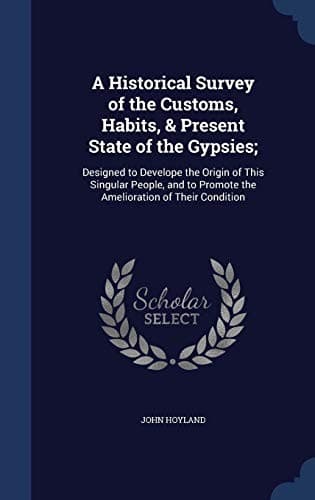
A Historical Survey of the Customs, Habits, & Present State of the GypsiesHoyland, John
History
A Historical Survey of the Customs, Habits, & Present State of the Gypsies
Hoyland, John
Romanies
The distribution proposed, would admit of these itinerants seeing their
children once in the year. But to extirpate Gypsey habits, education
alone would not be sufficient. Yet as there is no reason to think this
people are less susceptible than others, of gainful considerations, a
fund might be provided, out of which, twenty pounds should be paid with
each boy, on his apprenticeship to some handicraft business, in lieu of
finding him with clothes during the term. And in consideration of its
being faithfully served, five pounds might be allowed to find the young
man with tools for his trade, or otherwise setting him forward in the
world. This would excite an interest in civil associations and order,
which are necessary for the successful prosecution of trade; and
probably, an encouragement like this, would have a greater effect in
giving a new direction to Gypsey pursuits, than any coercive or
restrictive measures which could be devised. And who would not wish to
contribute to the means of rescuing from ignorance and vice, such a
portion of the population of their country! Who would not be desirous of
emulating in some degree, that best kind of patriotism, by which the
correspondent H. of the Christian Observer, is so remarkably
distinguished!
This would be an example worthy of a great nation; and is it not
probable, that the prospect of so much preferment, would induce Gypsey
parents, to promote to the utmost of their power, a disposition in their
children to obtain it? Cooper, a Gypsey at Chingford Green, said, “It is
a pity they should be as ignorant as their fathers.” This may be
considered as the language of “_help us_,” accompanied with this
acknowledgment, “_for we are unable to help ourselves_;” and certainly
there is but too much reason to conclude it is strictly true, respecting
the instruction of this forlorn and destitute race.
According to the enumeration of Gypsey lodgers, given in Section X, their
families average 5½ in number. This exceeds by one half, what is
reported to be the average of England in general. If we take Gypsey
population at 18,000, their children will be 12,000. Supposing
two-thirds of these to be under twelve years of age, there would be 8,000
to educate. Reckoning half that number to be girls, 4,000 boys would be
to be apprenticed after leaving school. And if these, after their
apprenticeship, married Gypsey girls, who had been brought up to service
in families, twenty thousand useful subjects might be calculated upon as
gained to the State in the first generation.
Public-domain text, read in full here on John Shaqi.
Reviews
Reviews
No reviews yet
Be the first to share your thoughts on this work.
Elsewhere in the archive
Join the Discussion
Join the discussion
Sign in to leave a comment or review.
Sign InorCreate an account