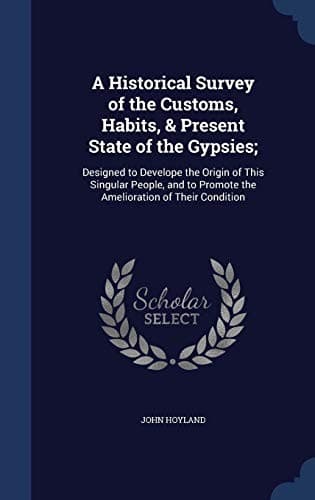
A Historical Survey of the Customs, Habits, & Present State of the GypsiesHoyland, John
History
A Historical Survey of the Customs, Habits, & Present State of the Gypsies
Hoyland, John
Romanies
“The principles of decorum, of propriety, and of virtue, are instilled
into the youthful mind; and by a powerful reaction, they reach the heart
of the parent; the moral atmosphere extends—its benefits are felt and
appreciated—the Bible takes its proper place in the habitations of
poverty; and thus in its simple, natural, and certain course, the _germ_
of _instruction_ yields the happy fruit of _moral reformation_.”
If as Grellmann computes, there are not fewer than 700,000 of these
people in Europe, who do not either plough, or sow, or the greater part
of them contribute in any manner to the improvement of the country, or
the support of the State, what a subject is this, for the contemplation
of Governments!
In reference to England, it is a beautiful exclamation of the Christian
Observer: “Surely when our charity is flowing in so wide a channel,
conveying the blessings of the gospel to the most distant quarters of the
globe, we shall not hesitate to water this one barren and neglected
field, in our own land.” Uniting cordially in this appeal, it is a great
satisfaction to be able to state, there are traits of character in this
people, which encourage attention to Gypsey soil. Let it but be cleared
of weeds, and sown with good seed, and the judicious cultivator may
calculate upon a crop to compensate his toil.
Greater proof of confidence, as to money transactions, not being
misplaced in Gypsies need not be given, than in the testimony of the
landlord at Kirk Yetholm, to William Smith, that his master knew he was
as sure of their money, as if he had it in his pocket.
In Dr. Clarke’s Travels, published in the present year, Part the 2nd of
Section 3rd, page 592, are the following observations respecting the
Gypsies of Hungary: “The Wallachian Gypsies are not an idle race. They
might rather be described as a laborious people; and the greater part of
them honestly endeavour to earn a livelihood. It is this part of them
who work as gold-washers.”
In page 637, the Doctor remarks: “The Wallachians of the Bannat, bear a
very bad character, and perhaps many of the offences attributed to
Gypsies, may be due to this people, who are the least civilized, and the
most ferocious of all the inhabitants of Hungary.” {262}
Could grateful sensibility of favors received, and of personal
attachment, be more strikingly evinced than in the promptitude of Will
Faa, who when he was eighty years of age, on hearing of his landlord
being unwell, undertook, at the hazard of his life, a journey of a
hundred miles, to see him before he died?
Public-domain text, read in full here on John Shaqi.
Reviews
Reviews
No reviews yet
Be the first to share your thoughts on this work.
Elsewhere in the archive
Join the Discussion
Join the discussion
Sign in to leave a comment or review.
Sign InorCreate an account