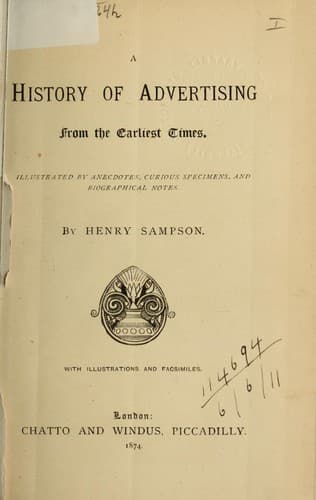
A History of Advertising from the Earliest Times.Sampson, Henry
History
A History of Advertising from the Earliest Times.
Sampson, Henry
Advertising -- History
“The great art in writing advertisements, is the finding out a proper
method to catch the reader’s eye, without which a good thing may pass
unobserved, or be lost among commissions of bankrupt. Asterisks and
hands were formerly of great use for this purpose. Of late years the
N.B. has been much in fashion, as also little cuts and figures, the
invention of which we must ascribe to the author of spring-trusses. I
must not here omit the blind Italian character, which being scarce
legible, always fixes and detains the eye, and gives the curious reader
something like the satisfaction of prying into a secret.
“But the great skill in an advertiser is chiefly seen in the style which
he makes use of. He is to mention the ‘universal esteem,’ or ‘general
reputation’ of things that were never heard of. If he is a physician or
astrologer, he must change his lodgings frequently; and though he never
saw anybody in them besides his own family, give public notice of it,
‘for the information of the nobility and gentry.’ Since I am thus
usefully employed in writing criticisms on the works of these diminutive
authors, I must not pass over in silence an advertisement, which has
lately made its appearance and is written altogether in a Ciceronian
manner. It was sent to me with five shillings, to be inserted among my
advertisements; but as it is a pattern of good writing in this way, I
shall give it a place in the body of my paper.
“The highest compounded Spirit of Lavender, the most glorious, if the
expression may be used, enlivening scent and flavour that can possibly
be, which so raptures the spirits, delights the gusts, and gives such
airs to the countenance, as are not to be imagined but by those that
have tried it. The meanest sort of the thing is admired by most
gentlemen and ladies; but this far more, as by far it exceeds it, to
the gaining among all a more than common esteem. It is sold in neat
flint bottles, fit for the pocket, only at the Golden Key in Wharton’s
Court, near Holborn Bars, for three shillings and sixpence, with
directions.
Public-domain text, read in full here on John Shaqi.
Reviews
Reviews
No reviews yet
Be the first to share your thoughts on this work.
Elsewhere in the archive
Join the Discussion
Join the discussion
Sign in to leave a comment or review.
Sign InorCreate an account