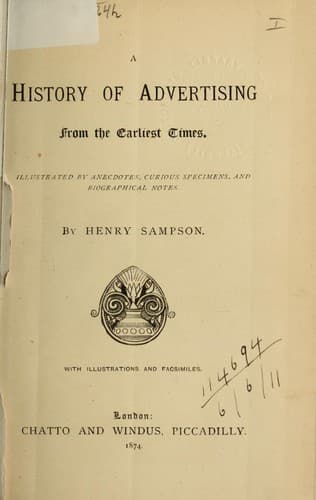
A History of Advertising from the Earliest Times.Sampson, Henry
History
A History of Advertising from the Earliest Times.
Sampson, Henry
Advertising -- History
That the practice of inserting “dummy” advertisements for the purpose of
drawing others had been adopted before this, is shown by a caution
inserted in the _Public Advertiser_ of January 1, 1765, though why
theatrical managers should have objected to gratuitous publicity we
cannot understand. Misrepresentation of the title of a play to be
performed would rarely act detrimentally, while it would often be
beneficial. Managers of the present day never object to anything but
adverse criticism in a newspaper, and this affects them in various ways.
Critics may be as favourable as they like, but let them condemn a piece
and they raise a storm not easily allayed. The managerial feeling is
then shown at once. Sometimes the advertisement of the theatre is
summarily stopped, at others the usual first-night privilege is
suspended, and not rarely of late years letters have been written and
published showing how utterly biassed the criticism has been. But not
one of the whole theatrical fraternity ever objects to a gratuitous
advertisement. Even a man who comes on with a message likes it, though
he in common with all the outsiders of “the profession” affects to
despise criticism, and will, on the slightest provocation, speak about
well-known writers for the press in a most contemptuous manner. But here
is the advertisement:--
THE Managers of Drury Lane think it proper to give notice that
Advertisements of their Plays by their authority are published only in
this Paper and the _Daily Courant_, and that the Publishers of all
other Papers who presume to insert Advertisements of the same Plays,
can do it only by some surreptitious intelligence or hearsay which
frequently leads them to commit gross Errors, as mentioning one Play
for another, falsely representing the Parts, etc. to the
misinformation of the Town and the great detriment of the said
Theatre.
As different in style as it is distant in date and place of publication
is the next item which attracts our attention. It looks suspiciously
like a hoax, for though other Newcastle papers of the time have been
rigorously searched, no news is discovered of Mrs Bell having shared the
fate which is said to overtake all who pry unduly into the secrets of
the Craft for the purpose of making capital out of their information.
The advertisement appears in the _Newcastle Courant_ of January 4, 1770,
and runs as follows:--
Public-domain text, read in full here on John Shaqi.
Reviews
Reviews
No reviews yet
Be the first to share your thoughts on this work.
Elsewhere in the archive
Join the Discussion
Join the discussion
Sign in to leave a comment or review.
Sign InorCreate an account