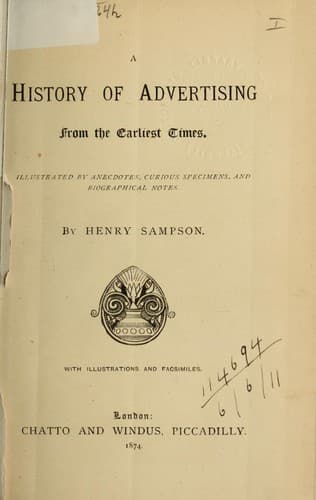
A History of Advertising from the Earliest Times.Sampson, Henry
History
A History of Advertising from the Earliest Times.
Sampson, Henry
Advertising -- History
The Burgomasters and Council of the town of Utrecht have been pleased
to found in this old and famous town, an illustrious school
[university], at which will be taught and explained the sacred
Theology and Jurisprudence, besides Philosophy, History, and similar
sciences. And it will commence and open at Whitsuntide of this present
year.
A few days after, on June 7th, the inauguration of this school is
advertised as about to take place on the ensuing Tuesday. There is one
instance of an advertisement from a foreign country being inserted in
this paper; it runs as follows, and is dated June 2, 1635:--
Licentiate Grim, British preacher and professor at the University of
Wesel, has published an extensive treatise against all popish
scribblers, entitled “Papal Sanctimony,” that is, catholic and
authentic proof that Pope John VIII., commonly called Pope Jutte
[Joan], was a woman.
In England the first bonâ fide attempt at newspaper work was attempted
in 1622, when the outbreak of the great Civil War caused an unusual
demand to be made for news, and as the appetite grew by what it fed on,
this unwonted request for information may be regarded as the
fount-spring of that vast machine which “liners” delight to call “the
fourth estate.” It was this demand which suggested to one Nathaniel
Butler, a bookseller and a pamphleteer of twelve years’ standing, the
idea of printing a weekly newspaper from the Venetian gazettes, which
used to circulate in manuscript. After one or two preliminary attempts,
he acquired sufficient confidence in his publication to issue the
following advertisement:--
If any gentleman or other accustomed to buy the weekly relations of
newes be desirous to continue the same, let them know that the writer,
or transcriber rather, of this newes, hath published two former newes,
the one dated the 2nd and the other the 13th of August, all of which
do carry a like title with the arms of the King of Bohemia on the
other side of the title-page, and have dependence one upon another:
which manner of writing and printing he doth purpose to continue
weekly by God’s assistance from the best and most certain
intelligence: farewell, this twenty-three of August, 1622.
Public-domain text, read in full here on John Shaqi.
Reviews
Reviews
No reviews yet
Be the first to share your thoughts on this work.
Elsewhere in the archive
Join the Discussion
Join the discussion
Sign in to leave a comment or review.
Sign InorCreate an account