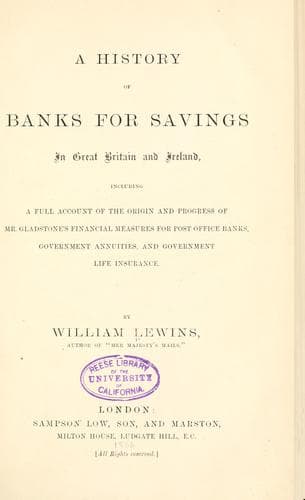
A History of Banks for Savings in Great Britain and IrelandLewins, William
History
A History of Banks for Savings in Great Britain and Ireland
Lewins, William
Postal savings banks -- Great Britain; Savings banks -- Great Britain
Few members questioned the wisdom of the proposals at this time, but
many expressed themselves dissatisfied that the bill would have no
reference to the past, and that the Chancellor had not alluded in any
way to the depositors who had lost their all by the bank failures and
by the action of the bill of 1844. Mr. Crawford spoke of the Rochdale
depositors, Mr. Fagan of the Killarney depositors, and Mr. Herbert of
the Dublin and Tralee depositors. _Mr. Slaney_ thanked the Chancellor
of the Exchequer for the amount of attention which he had bestowed on
the bill, which he "deliberately thought would interest more persons
than any other measure that would be introduced this session." He
thought the security now promised would be real, though he was sorry
the Chancellor meant to make the people pay for it. His opinion (and
he had considered the subject of industrial investments very largely)
was that neither the amount of, nor the interest on, deposits should
be reduced; he would "be most willing to pay a small bonus to tempt
the savings of these poor people." We are glad, however, to say that
this view of the case did not meet with much approval. After several
more appeals from such members as Mr. Bankes and Colonel Thompson,
that Government would come to the rescue of the defrauded depositors
who had, in their ignorance it might be, looked to the country for
security, the bill was ordered to be brought in by the Chancellor and
Mr. Attorney-General. On the motion made to read the bill a second
time on the 8th of August, 1850, Mr. Hume and Sir Henry Willoughby
importuned the Chancellor of the Exchequer to defer the consideration
of the bill to the next session; the former urging that honourable
members might study the reports of the Committees of 1849-50, during
the interim, and the latter that time might be given "to allow of a
consolidation of all the statutes relating to Savings Banks, and an
inquiry into the whole subject." The Chancellor replied, that after
the agitation which had been got up among the managers of Savings
Banks, and the considerable misunderstanding which prevailed relative
to the provisions of the bill, he reluctantly consented to withdraw
it.[91] Several members took the opportunity to urge that the
Chancellor should bring the matter forward the first thing in next
session; but the Savings Bank interest proved still stronger in 1851,
and again Sir Charles Wood got nothing done, and never heartily took
up the question again.
Public-domain text, read in full here on John Shaqi.
Reviews
Reviews
No reviews yet
Be the first to share your thoughts on this work.
Elsewhere in the archive
Join the Discussion
Join the discussion
Sign in to leave a comment or review.
Sign InorCreate an account