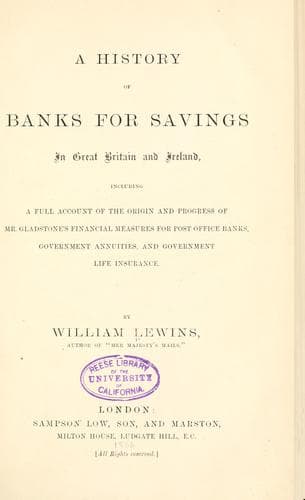
A History of Banks for Savings in Great Britain and IrelandLewins, William
History
A History of Banks for Savings in Great Britain and Ireland
Lewins, William
Postal savings banks -- Great Britain; Savings banks -- Great Britain
want or old age. The bill was read a third time, with a majority of 28
in a House of 56 members, and soon afterwards passed without any
further difficulty, and received the Royal Assent. Such a measure,
whatever the poorer classes might think of it, was well calculated to
spread the spirit of independence amongst them. The State did well to
offer the opportunity of increased facilities; and if those for whose
benefit such schemes were intended did not avail themselves of them to
secure, by a very small amount of temporary sacrifice in seasons of
health and prosperity, a provision against those risks to which all
the poorer classes are liable, of falling through unexpected
contingencies into poverty and pauperism, the blame would rest
elsewhere than with the State.
As we have already said, the session of 1851 passed without any
attempt at legislation, and in the beginning of 1852, there being
still no sign of action on the part of the Executive, the late _Mr.
Herbert_, so well known in connexion with the Irish banks, proposed a
resolution to the effect--
"That this House has observed with regret the continued
neglect of Her Majesty's Government to fulfil their
promise of introducing a bill for the regulation of
Savings Banks, by which those important institutions may
be enabled to preserve their hold on the confidence of the
country, and a due encouragement be thus given to the
industry and providence of the working classes."
There was every reason to believe that this resolution would have
passed, until the Chancellor of the Exchequer rose. _Sir Charles Wood_
admitted that the bill had been far too long delayed; but this was no
fault of his. It was thrown out in 1850; he could not get it
introduced in 1851: it was ready, however, and it should be brought
forward this session. He had not given notice of it, because he had
been engaged in consultation with several members in so preparing the
measure as to ensure its passage through the House. His firm
conviction was, that the delay in the present instance had tended not
only to improve the bill, but to diminish the chances of opposition to
it when introduced. During the last four years the greatest pains had
been taken to frame such a measure as should effectually remove the
evils that had been complained of; and within the past few months they
had had the assistance of a new Comptroller of the National Debt
Office, who had "devoted himself with great diligence to the
subject."[92] He submitted, in conclusion, that he was not deserving
of the censure of the House, especially as it had been settled to try
the measure again during the present session. _Mr. Disraeli_ agreed
with Sir Charles Wood, though the resolution before the House was
apparently justified by the circumstances, it would not be becoming in
them to divide the House after what had been promised. The question
was surrounded with difficulties, but notwithstanding these
Public-domain text, read in full here on John Shaqi.
Reviews
Reviews
No reviews yet
Be the first to share your thoughts on this work.
Elsewhere in the archive
Join the Discussion
Join the discussion
Sign in to leave a comment or review.
Sign InorCreate an account