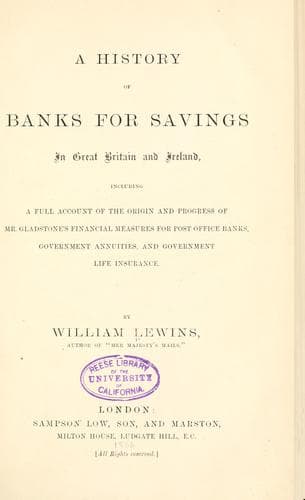
A History of Banks for Savings in Great Britain and IrelandLewins, William
History
A History of Banks for Savings in Great Britain and Ireland
Lewins, William
Postal savings banks -- Great Britain; Savings banks -- Great Britain
of depositors, who have no share themselves in the management of
their bank. It appears to your Committee that an alternative ought
to be given, and freely offered to the choice of trustees, either
to secure the guarantee of Parliament upon such conditions as the
commission shall prescribe, or themselves to undergo the same
liability in regard to Savings Banks as was enacted by 9 Geo. IV.
c. 92, s. 9. The able actuaries connected with various large
banks, who have attended your Committee, have detailed various
methods by which imposition and error may be rendered almost
impossible in large establishments; but in the case of the smaller
banks, where the funds are not adequate to provide a staff of paid
officers, it will be for the Commission to see what arrangements
they can make to check misconduct, and to afford to depositors, at
least once a year, a certainty that their money has been duly
lodged with the Government, for which purpose some valuable
suggestions were made by several of the witnesses experienced in
the practical management of banks. In one point all the witnesses
concur; and your Committee must record their own opinion to the
same effect, that the most effectual restraint upon malversation
is to be found in the presence of a second party in every
transaction where money is paid or received; and that a rule to
this effect ought to be imperative in all banks, under a penalty
on its infringement."
[102] The Committee sat six days deliberating on their Report
after all the witnesses had been examined. Draft reports were
proposed by Mr. Ayrton, Sir Henry Willoughby, and the Chairman,
the report ultimately carried, after a few emendations, being that
by Mr. Estcourt.
[103] Sir Alexander Spearman, who clearly explained the facts to
the Committee of 1858, also described the routine gone through
when Savings Banks made investments with Government. They first
certify the appointment of trustees; then, appoint an agent in
London, generally a banker, through whose hands the money passes.
When the trustees of a Savings Bank wish to invest, they send up a
notice to their agent, who presents it at the National Debt
Office, where an order is given to the Bank of England to receive
the stipulated sum and place it to the account of the fund for the
Banks for Savings. Next morning a receipt is sent from the Bank of
England to the National Debt Office, and from thence to the
trustees who remitted the money. A somewhat similar proceeding
takes place on the trustees of any Savings Bank wishing to
withdraw money. It is done through the agent, who gives the
necessary notice of withdrawal. No money is paid or received at
the National Debt Office, but at the Bank of England, the
Commissioner simply keeping the accounts.
Public-domain text, read in full here on John Shaqi.
Reviews
Reviews
No reviews yet
Be the first to share your thoughts on this work.
Elsewhere in the archive
Join the Discussion
Join the discussion
Sign in to leave a comment or review.
Sign InorCreate an account