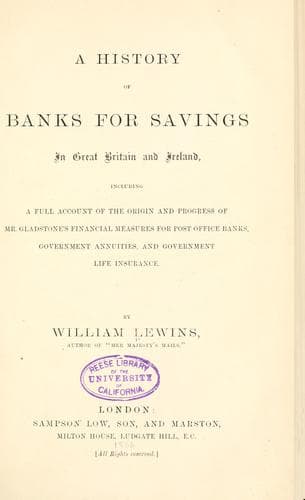
A History of Banks for Savings in Great Britain and IrelandLewins, William
History
A History of Banks for Savings in Great Britain and Ireland
Lewins, William
Postal savings banks -- Great Britain; Savings banks -- Great Britain
[107] Exchequer-bill purchases, as we gather from the evidence
taken before the Committee of Inquiry, are made in two modes. If
the purchases are to be made in the market, the Cashier of the
bank is directed in the same manner as when he is told to purchase
Stock; pays for the bills out of the Savings Bank fund, and
carries them to the credit of the Commissioners. The other mode
is, by the issue of temporary Exchequer bills, such as Deficiency
bills, or Ways and Means bills. Deficiency bills are bills issued
under the authority of 57 George III., to enable the Government to
provide for a temporary deficiency of money in the Exchequer.
Deficiency bills are issued either to the Bank of England, or held
temporarily by the National Debt Commissioners through the bank,
the bank paying the money to the Exchequer, and paying itself the
next day out of the Savings Bank fund. Ways and Means bills are of
a pretty similar character, but chargeable to the revenue of the
next succeeding quarter, and not, as in the former case, of the
current one. Supply bills are of a still more permanent character,
and are often held on from year to year, and are exchanged from
year to year.
[108] Mr. Boodle was for allowing part of the money to be
otherwise invested than with Government. He suggested land
drainage. Mr. Sturrock and Mr. Sikes were for keeping one-third of
the money in the hands of trustees, to be invested "in freehold
securities of unquestionable character," or in railway debentures.
Mr. Deaker, Mr. Jameson, and Mr. Finney agreed. Lord Monteagle was
"driven to the conclusion" of saying that in investing Savings
Bank deposits, "you ought to deal in State securities and nothing
else." The opinion of the Committee on the subject may of course
be gathered from the digest of their report already given.
[109] The indefatigable bank managers of London again sent round
petitions against the proposals, and when they were presented to
the House, one member, Mr. Hubbard, remarked they "were all
apparently from one mint:" and indeed no secret was made of its
being so.
[110] So convinced was one individual organ--accustomed to treat
largely of such subjects--that the bill now proposed would fail to
accomplish any good, that it insisted upon its being called a
"Bill to provide for the speedy extinction of all old Savings
Banks, and to give a heavy blow and great discouragement to the
trustees and managers thereof."
[111] _Hansard_, vol. clxvi. p. 1394.
Public-domain text, read in full here on John Shaqi.
Reviews
Reviews
No reviews yet
Be the first to share your thoughts on this work.
Elsewhere in the archive
Join the Discussion
Join the discussion
Sign in to leave a comment or review.
Sign InorCreate an account