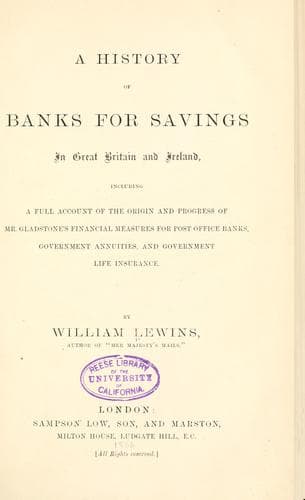
A History of Banks for Savings in Great Britain and IrelandLewins, William
History
A History of Banks for Savings in Great Britain and Ireland
Lewins, William
Postal savings banks -- Great Britain; Savings banks -- Great Britain
population in full, the Perth institution came forward with--nothing
better than advice![121] It surely cannot be a matter of surprise that
the bank was "never re-opened," and that "no private gentlemen could
be found to undertake the trouble _or risk for the future._"
We have hitherto been concerned almost entirely with Irish Bank
frauds; henceforth we shall have to deal exclusively with English
ones. Not only on account of the date of its occurrence, but from its
magnitude and enormity, the fraud on the Rochdale Savings Bank
deserves the first place. It is not too much to say that no Savings
Bank defalcation equalled this one in the depth of its iniquity and
cunning, and in the disastrous effects which followed, affecting as
they did the growth of provident habits not merely in that particular
locality, but throughout the entire kingdom.
The Rochdale Savings Bank was commenced in 1818, or immediately after
those institutions were recognised by the State. It seems to have been
started in the usual way, and to have progressed with great
rapidity,--the community about Rochdale forming a very favourable
specimen of the Lancashire people. In 1822, George Haworth, a young
man of twenty-one, succeeded his father, John Haworth, who had been
actuary of the bank since its commencement. As the son remained with
the bank almost till its affairs were wound up in 1849, he may be said
to have been associated with it through its whole course of thirty
years. When very young, this man appears to have shown extraordinary
energy and talent for business, and each year he not only added to his
engagements, but seemed to accomplish all he undertook with equal
readiness. In addition to his duties at the bank, he first took an
agency for the sale of wool, then, as now, the staple trade of the
town; then he obtained an agency for the sale of porter, both from a
Dublin and a London house. Latterly, however, he had advanced himself
to the dignity of cotton spinner, and was occupier of a large factory;
was at the same time a land agent, estate agent for several gentlemen
who possessed large properties in the neighbourhood, an insurance
agent, and valuer and receiver of rents for the Lancashire and
Yorkshire Railway Company. Not less on account of his more private
character than from those multifarious matters with which he was
connected, Mr. Haworth was a man of mark in the place. He was a member
of the Society of Friends, and this of itself was a password to the
trust and confidence of many men.[122] Whenever anybody wanted a
chairman, or sought a little patronage for anything literary,
scientific, or charitable, resort was had to "Friend Haworth;" "he
always patronised such things as far as he could;" and who could do
more, especially one who was "not himself a particularly talented
man?"[123] "Talented" he might not be in the ordinary acceptation of
the term, nor indeed need he have been, to do this much; but never was
Public-domain text, read in full here on John Shaqi.
Reviews
Reviews
No reviews yet
Be the first to share your thoughts on this work.
Elsewhere in the archive
Join the Discussion
Join the discussion
Sign in to leave a comment or review.
Sign InorCreate an account