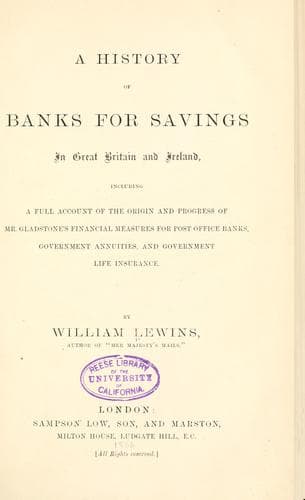
A History of Banks for Savings in Great Britain and IrelandLewins, William
History
A History of Banks for Savings in Great Britain and Ireland
Lewins, William
Postal savings banks -- Great Britain; Savings banks -- Great Britain
In seven years from this time, Mr. Hatton was engaged upon an equally
unfortunate business in connexion with the Savings Bank at Brighton. A
deficiency was found out in this bank in 1849, to the extent of nearly
4,000_l._, and was proved to have arisen from falsifications in the
accounts of Mr. Buckoll, who for many years had been actuary of the
bank. The first suspicion of anything being wrong was felt by one of
the managers, who, somewhat shrewder than the rest, went carefully
through the balance-sheet of the year 1848, under the impression that
the amount of profits ought to have been larger. He was unable to do
more, however, than confide his suspicions to the actuary of the
Reading bank, and to request his opinion. After Mr. Hatton had
examined into the amount of business done, and compared the business
with the capital and the various items presented to him, he expressed
his opinion that the profits on the year should have been at least
100_l._ more than they appeared to be. Strengthened in his opinion by
this advice from an experienced actuary, the manager in question, at
the annual meeting held immediately afterwards, got up and said that
he did not feel satisfied with the balance-sheet, and moved that the
meeting should adjourn for a short time for some investigation to be
made. A close examination of the accounts was so little to Mr.
Buckoll's mind that he "decamped," leaving a letter for the managers,
in which he stated how unworthy he had been of the position he had
filled, having committed frauds on the funds of the bank to a
considerable extent. A warrant was immediately issued for his
apprehension, with a view to criminal proceedings, but he got clear
away; and up to within a few years ago had never been heard of. Mr.
Hatton, who succeeded eventually to the situation which Buckoll
filled, was called in to pursue the investigation into the case, and
it is from his evidence before the Committee, already so often alluded
to, that we are enabled to extract some account of the way in which
the frauds were accomplished. The actuary, it seems, made false
entries in depositors' books, false entries in the ledgers, and forged
the initials of managers, who were required to certify to each entry
in the latter. If he wished to draw 100_l._ from the funds of the
bank, his plan was to get hold of a pass-book,--a new one, if he could
not find an old one readily,--forge entries in that book as well as
corresponding entries in the ledger; this book he would present to the
managers in attendance, who readily paid the amount. In some cases the
money was left with Buckoll to pay over to the _quasi_ depositor, as
was then too much the custom all over the country. Afraid, however, to
do too much of this sort of work himself, he arranged in several cases
to have the money paid on what is known as a power of attorney, or an
order for payment to a second party. Thus he went among his friends,
Public-domain text, read in full here on John Shaqi.
Reviews
Reviews
No reviews yet
Be the first to share your thoughts on this work.
Elsewhere in the archive
Join the Discussion
Join the discussion
Sign in to leave a comment or review.
Sign InorCreate an account