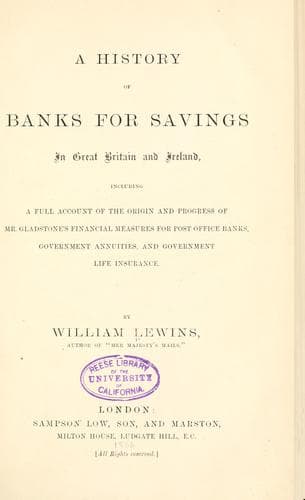
A History of Banks for Savings in Great Britain and IrelandLewins, William
History
A History of Banks for Savings in Great Britain and Ireland
Lewins, William
Postal savings banks -- Great Britain; Savings banks -- Great Britain
From 1851 to 1861 there were numerous instances of frauds in Savings
Banks, all which cases will he found included in a list at the end of
this chapter, though not described at any length. It is the less
necessary to do so, as nearly all of them are fully described in
reports made by Mr. W. H. Grey, a professional actuary, who had long
been experienced in Savings Bank matters, and who had been sent down
by the National Debt Commissioners to investigate such cases as they
arose. It would appear from his reports that most of them were
imitations on a small scale of the gigantic frauds already described
in detail. The common feature of almost every case was extreme laxity
of book-keeping;[126] nothing like a proper audit; and signatures
given by responsible persons without even a cursory examination. Thus
in the Isle of Wight Savings Bank at Newport, Mr. Grey's testimony is,
that he found that "fictitious documents, purporting to be signed by
depositors, giving notice of their intention to withdraw a part or the
whole of their deposits, have been produced by the secretary, on the
faith of which cheques have been signed by the attending manager
without seeing the pass-book, and without ascertaining whether such
sums were really standing in the ledger or not. These cheques have
been entrusted to the secretary for delivery to the depositors at any
time they might call for them, instead of insisting on personal
attendance during bank hours." The actuary of the Rugby bank committed
his frauds in the same way. Again: "In some cases, fictitious accounts
had been raised in the ledgers, and closed again immediately
fraudulent repayments had been made; and in other cases in which the
amounts had been previously withdrawn, the dates of the real
withdrawals had been altered into those of the fraudulent ones." No
comparison, it seems, was ever instituted between the cash-book and
the ledger, and the system pursued had practically left the whole
control of the receipt and payment of about 30,000_l._ a-year to one
individual. The secretary, indeed, William Wheeler Yelf, "was
generally much respected in the island," was distributor of stamps,
did a large business on week days, and was employed as a Wesleyan
preacher on Sundays; but we have seen how much all this, and more,
avails where the man is thrown amongst overwhelming temptations and
has no principles to guide him. We have already spoken of many of the
results of the Rochdale fraud; the case of the Isle of Wight bank
shows that that fraud affected other banks. It was suggested after the
failure of the Rochdale bank that the trustees of every other
institution should at once set about a rigid comparison of the
depositors' books with the books of their respective banks. The
Newport trustees at once acted upon the suggestion of the National
Debt Commissioners. They established the practice of having the
balance-book containing a list of the balances due to depositors
Public-domain text, read in full here on John Shaqi.
Reviews
Reviews
No reviews yet
Be the first to share your thoughts on this work.
Elsewhere in the archive
Join the Discussion
Join the discussion
Sign in to leave a comment or review.
Sign InorCreate an account