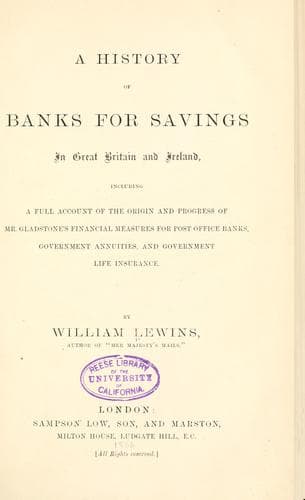
A History of Banks for Savings in Great Britain and IrelandLewins, William
History
A History of Banks for Savings in Great Britain and Ireland
Lewins, William
Postal savings banks -- Great Britain; Savings banks -- Great Britain
Were we to take the first five years of this last decennial period, we
should find that there had absolutely been a _decrease_ in the
business of Savings Banks to the extent of _twelve per cent._, but
this unsatisfactory result admits, as we have just shown, of partial
explanation. To continue our survey, however, up to the latest period,
viz. including the Returns for 1864, we find that the deposits for
1854 amounted to 7,400,141_l._, and the deposits for 1864 to
8,174,679_l._, showing an increase during ten of the most prosperous
years this country has known since the establishment of Savings Banks
at the rate of only about eight per cent.
It is almost unnecessary to say that as regards all the material
elements of prosperity the progress of the country between 1841 and
1861 was most marked. Taking England and Wales only, we find the
amount deposited in Savings Banks in 1841 was 4,440,379_l._; in 1861,
the amount deposited was 7,188,034_l._ Now the population of England
and Wales was in 1841 15,929,000; in 1861 it was 20,119,496. The
declared value of our exports was in 1841, 51,545,116_l._; in 1861 it
had increased to the enormous sum of 125,102,814_l._, and last year
(1865) it stood at over 165 millions sterling. What the increase in
the amount paid as _wages_ was likely to be, we leave our readers to
estimate from these sums. In nothing is the national prosperity more
manifest than in the relative number of paupers in receipt of relief.
Though the population increased during the twenty-two years in
question several millions, the total number receiving in and out-door
relief, was, in 1849 (this being the first year the return was made)
934,419; in 1861, the number was 890,423, or an actual decrease of
forty-four thousand persons. Such statistics as the above might be
multiplied indefinitely, especially those relating to the wonderful
progress of the Money Order Office at the Post-Office, but it may
suffice just to make a reference to the increase of wages during the
period.[135] Mr. David Chadwick, an eminent authority in Lancashire,
states that between 1840 and 1860 the wages of the operatives employed
in the different departments of the cotton trade had increased from 12
to 28 per cent.; in the silk trade the increase had been 10 per cent.
In the building trade the increase throughout the country had averaged
from 10 to 30 per cent.; in the iron trade from 8 to 20 per cent. It
would scarcely, therefore, be too much to say that within the period,
_and up to_ 1861, while the price of most kinds of food had decreased,
the wage for almost every description of labour had increased in at
least an equal proportion.
Public-domain text, read in full here on John Shaqi.
Reviews
Reviews
No reviews yet
Be the first to share your thoughts on this work.
Elsewhere in the archive
Join the Discussion
Join the discussion
Sign in to leave a comment or review.
Sign InorCreate an account