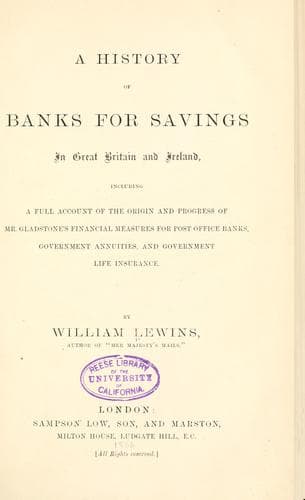
A History of Banks for Savings in Great Britain and IrelandLewins, William
History
A History of Banks for Savings in Great Britain and Ireland
Lewins, William
Postal savings banks -- Great Britain; Savings banks -- Great Britain
could scarcely be thought ignorant in financial questions of this
kind, show how wide-spread must have been the misapprehension, and are
of themselves almost a sufficient justification of the ignorance of
the bulk of the poorer classes.
Nor were there wanting excellent and numerous authorities who must
have contributed to this improper impression. Mr. Scratchley, in his
_Practical Treatise on Savings Banks_, pp. 72-4, has taken great
pains[137] to string together a formidable list of those whom he finds
inculcating the same view as that already expressed by prominent
members of Parliament during debate. Suffice it to say, that when such
books as McCulloch's _Commercial Dictionary_, Porter's _Progress of
the Nation_, _The Quarterly Review_, _Chambers's Information for the
People_, _Chambers's Magazine_, _The Penny Magazine_, and the Irish
school books, laid it down that depositors had perfect security from
Government for the money paid into Savings Banks, those of the class
which relies to such a great extent on the intelligence of those above
them may well be excused for falling into error, and may well be
pitied when called upon to bear loss. Government took up the subject
of Savings Banks at an early stage in their history, with the object
of "protecting" them,[138] and to that end they made it an imperative
duty on the part of the trustees of these banks to deposit their money
with the State; unfortunately, however, no steps were taken to enforce
this provision. Here lay the fatal mistake, and the source of all the
trouble. "The whole success of Savings Banks," says Mr. McCulloch in
his _Statistics of the British Empire_, "depends upon the security the
depositors have for their money. No one was accustomed to speak of
Savings Banks without commenting on the increase in the stability of
the country by giving the poorer classes a direct interest in the
preservation of public credit; but it requires no great amount of
penetration to see that so much entirely depends upon the fact that
faith is kept with such depositors." To all intents and purposes
proper faith was _not_ kept by the banks, and a proper knowledge of
the real amount of risk the poor were running was wrongly withheld
from them: hence the undoing of a great part of the good work
accomplished in the first quarter of the present century by the
establishment of Savings Banks. "What was the use," indignantly asked
a member of the House of Commons of the Government in 1851, "of
preaching to the poor the duty of being honest, industrious, and
self-dependent, if the fruits of their hard earnings were thus to be
swept away?"
Public-domain text, read in full here on John Shaqi.
Reviews
Reviews
No reviews yet
Be the first to share your thoughts on this work.
Elsewhere in the archive
Join the Discussion
Join the discussion
Sign in to leave a comment or review.
Sign InorCreate an account