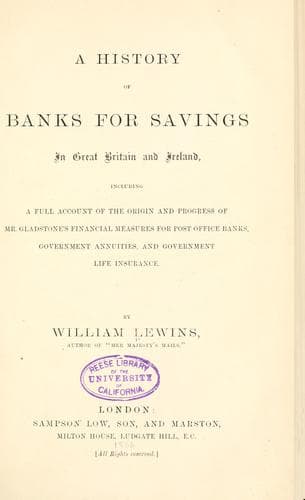
A History of Banks for Savings in Great Britain and IrelandLewins, William
History
A History of Banks for Savings in Great Britain and Ireland
Lewins, William
Postal savings banks -- Great Britain; Savings banks -- Great Britain
Still more useful and interesting has been the Penny Bank movement,
and some account, which must necessarily be brief, will not be out of
place here. Before the year 1850, there seem to have been at least
four Penny Banks established with a view to attract a poorer class of
depositors, or it might be a _younger_ class, than the existing
Savings Banks had reached; and, as "stepping-stones to greater
things," Penny Banks succeeded admirably from the very first. The
first bank was started, with this very laudable object, in Greenock,
in 1857, by a Mr. Scott of that town. The Greenock Savings Bank
having, like all the other Savings Banks, restricted the amount which
could be received to a shilling, and very few of them receiving that
amount pleasantly, Mr. Scott thought that the very poor had no safe
place in which to deposit their little surplus earnings. Poor people
were often enough urged to "take care of the pence, and the pounds
would take care of themselves;" but little had been done to help them
to care for their pennies, which proverbially and very quickly burnt
holes in their pockets when they were compelled to keep them in their
own possession. A bank for such sums was started in this town; and to
show how much it was needed, and how ready the poor were to avail
themselves of advantages when they were placed within their reach, we
have only to state that 5,000 depositors in the first year of the
existence of the Greenock Penny Bank, placed the sum of 1,580_l._ in
it.
The success of this bank soon began to tell all around; many private
establishments and charitable institutions were not long in following
the example that had here been set. In the following year Mr.
Queckett, a benevolent and painstaking clergyman, in the east of
London, established a Penny Bank in connexion with Christ's Church,
St. George's in the East, and the success attending the venture was
still more encouraging and remarkable; nearly 15,000 deposits
were made in this parish Penny Bank in the first year of its
existence. It seems that the number of depositors, for some reason
or other--probably because that number was enough for one person to
control; the whole of the repayments, at any rate, passed through Mr.
Queckett's own hands--was limited to 2,000; and so great was the
demand, that there were always several applicants for any vacancy that
might occur among the favoured two thousand. Two "Penny Banks" were
next established about the same period--one at Hull, in August, 1849,
and the other at Selby, in the East Riding of Yorkshire, in July of
the same year. The clergymen and gentry of both towns joined together
to form an institution, "which should create and foster habits of
regularity and frugal economy among the poorest people, and which
should afford an opportunity for the deposit and safe keeping of the
smallest sums of money, repayable with interest when required." The
Birmingham Penny Bank was established in 1851, and in six years from
Public-domain text, read in full here on John Shaqi.
Reviews
Reviews
No reviews yet
Be the first to share your thoughts on this work.
Elsewhere in the archive
Join the Discussion
Join the discussion
Sign in to leave a comment or review.
Sign InorCreate an account