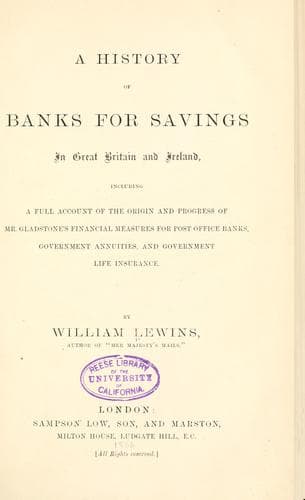
A History of Banks for Savings in Great Britain and IrelandLewins, William
History
A History of Banks for Savings in Great Britain and Ireland
Lewins, William
Postal savings banks -- Great Britain; Savings banks -- Great Britain
That these auxiliary banks are effecting a great amount of good can
well be believed. "The saving of pence," says the report from which
these extremely interesting facts are taken, "proves a training to
habits whereby ultimately larger sums are saved, and the virtues of
industry and providence are cultivated and confirmed," and there
cannot exist a doubt on the matter. The principles upon which they and
all other banks of the kind were started, and have been throughout
conducted, make them peculiarly institutions of a preliminary
character for the poorer class of workmen; emphatically they are, as
they have been called, "the poor man's purse." In their operations
they are so simple, that few could possibly get perplexed in dealing
with them; and they are best adapted to working populations, because
they are open at such hours, generally on Saturday nights, as are
known to suit these classes. As the most salutary change is made in a
man's habit, perhaps in his character, when he _begins_ to save, the
Penny Bank deserves every countenance and encouragement.[144]
It only remains to add, that the Legislature took the matter up in
August, 1859, when it passed the Act 22 and 23 Vict. c. 53,
legalizing, as it were, these institutions, by enabling them to invest
the whole of their proceeds in Savings Banks.
* * * * *
Much that remains to be told of Savings Bank reforms, and of other
proposals to supplement the system by fresh provisions, may be told in
connexion with the life of a gentleman to whom reference has already
been made. Amongst those who have devoted much time and immense labour
to bring about a better state of things in Savings Banks, the foremost
place is undoubtedly due to Mr. Charles William Sikes, of
Huddersfield. Mr. Sikes, the son of a private banker of that town, was
born in 1818. We will pass over his early years, only remarking that
he received a commercial education, and, in 1833, entered the employ
of the Huddersfield Banking Company, the third or fourth joint stock
bank established in this country. Subsequently cashier, Mr. Sikes now
holds the position of deputy manager of the bank in question. We
mention this, because it has an immediate bearing on the subject: it
was while Mr. Sikes was cashier of this bank,--which, like other
private banks, received deposits above 10_l._, and allowed interest at
the current rate,--that his attention was arrested to the question of
banks for the people. He witnessed a considerable number of instances
of workmen, who, beginning with a few pounds, had silently amassed
what was to them a little fortune, of one, two, and even three hundred
pounds; and he became deeply impressed, as he himself informs us, not
only with the idea that the number of these provident working people
was far less than it ought to be, or might be, but that the social and
domestic results for good that would ensue would be absolutely
Public-domain text, read in full here on John Shaqi.
Reviews
Reviews
No reviews yet
Be the first to share your thoughts on this work.
Elsewhere in the archive
Join the Discussion
Join the discussion
Sign in to leave a comment or review.
Sign InorCreate an account