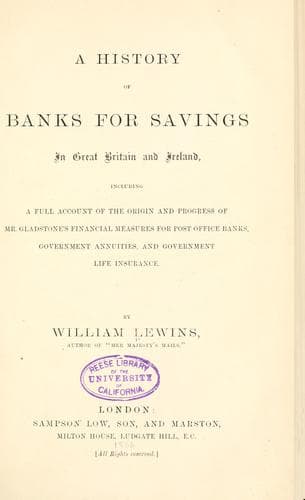
A History of Banks for Savings in Great Britain and IrelandLewins, William
History
A History of Banks for Savings in Great Britain and Ireland
Lewins, William
Postal savings banks -- Great Britain; Savings banks -- Great Britain
With this end in view, Mr. Sikes addressed a long letter to the editor
of the _Leeds Mercury_, in 1850, which was subsequently republished in
the form of a pamphlet, and widely circulated, recommending the
formation of what he called "Preliminary Savings Banks." There was
nothing particularly new in the character of the banks proposed; the
novelty was in their adaptation to the machinery of Mechanics'
Institutions. Mr. Sikes took up the Penny Bank movement, and showed,
with an energy and devotion to the subject which made his exertions
quite impressive, how, by the already existing institute, that useful
scheme for saving small sums might be propagated far and wide. His
proposal, to give it in brief, was, that a few leading members of each
Mechanics' Institute should form themselves into a "Savings Bank
Committee," attending, say, an evening weekly, in one of the
class-rooms, to receive the trifling deposits of any member who should
choose to "transact a little business" with them. They would only have
to appoint a treasurer, provide a few inexpensive books, and with the
exercise of just a little patience and self-denial they might succeed
in bringing many round to saving habits. The excellent organisation,
especially in Lancashire and Yorkshire, of Mechanics' Institutes,
would thus wonderfully augment the number of agencies for receiving
the savings of the people, and they would thus augment the number most
where more facilities were most needed. The "Preliminary" banks were
meant to be merely feeders to the larger banks: so soon as the money
of any one depositor reached a guinea, or two guineas, the sum was to
be paid into the nearest Government bank, as often as necessary. "If
the committee of each institution," concluded Mr. Sikes, in his very
interesting letter, "were to adopt this course, taking an interest in
their humble circumstances, and in a sympathising and friendly spirit,
suggest, invite, nay win them over, not only to reading the lesson,
but forming the habit of true economy and self-reliance, how cheering
would be the result! Once established in better habits, their feet
firmly set in the path of self-reliance, how generally would young men
grow up with the practical conviction that to their own advancing
intelligence and virtues must they mainly look to work out their own
social welfare!" It is very satisfactory to find that this advice and
such considerations had their proper weight with the committees of
many of these institutions: Penny Banks were added to their other
educational and social schemes; and Mr. Sikes was further encouraged
by the Committee of the Yorkshire Union of Mechanics' Institutes, who
more than once alluded to his proposals, and expressed their cordial
approval of his plan, and their pleasure that it had been adopted in
several places included in their sphere of operations. In the country
generally the proposals attracted for some time considerable
attention, and led to Mr.
Public-domain text, read in full here on John Shaqi.
Reviews
Reviews
No reviews yet
Be the first to share your thoughts on this work.
Elsewhere in the archive
Join the Discussion
Join the discussion
Sign in to leave a comment or review.
Sign InorCreate an account