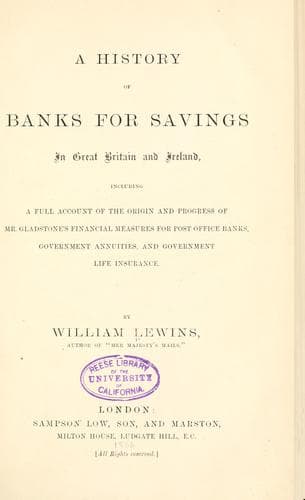
A History of Banks for Savings in Great Britain and IrelandLewins, William
History
A History of Banks for Savings in Great Britain and Ireland
Lewins, William
Postal savings banks -- Great Britain; Savings banks -- Great Britain
Mr. Sikes, after thus recapitulating in his able pamphlet the
imperfections in the organization and management of Savings Banks,
advocated the following improvements, viz.:--That the State should
give a perfect guarantee; that there should be a central bank in
London to control the whole system, in the same way that the central
Money Order Office controlled all money-order operations at the Post
Office; that there should be a vigilant and general audit of all
accounts; that there should be a great extension of the hours during
which Savings Banks were open; a great increase in the number of such
banks--the services of private and joint-stock banks to be called into
requisition in cases where such arrangement was likely to prove
economical and advantageous; that there should be an increase in the
facilities for the deposit and withdrawal of money; that one-fourth of
the capital of Savings Banks should be employed in first-class landed
securities and railway mortgage bonds, yielding four per cent. Mr.
Sikes further proposed that the rate of interest on sums up to 100_l._
should be three per cent., and two and a half per cent. on all sums
beyond. Mr. Sikes felt the difficulty of providing that essential
Government guarantee for every deposit, without which any reform in
Savings Banks was scarcely worth the name; but he strongly insisted on
the point that if a Savings Bank department was established in London,
which should, on its part, insist upon weekly returns, a good and
uniform system of book-keeping, and a liability to unapprised visits
by inspectors from the London office, the entire staff of Savings Bank
officials in the country might, to a great extent, be kept honest.
Bearing in mind, however, that errors and losses would occur to the
best regulated department, he further proposed that the treasury might
be made safe by the establishment of a "General Guarantee Fund,"[148]
to which contributions should be made from the "Separate Surplus
Fund." These suggestions, if carried out, Mr. Sikes believed would
help to form the basis of a system that would restore Savings Banks to
the estimation in which they were held during the first twenty years
of their existence; and there can be no doubt of it. The difficulty
was, however, in getting such recommendations adopted--either because
the then Chancellor of the Exchequer (Sir G. C. Lewis) did not bring
his extraordinary powers to bear upon the subject, or else there was
still something lacking to give a more practical turn to the questions
at issue. As subsequent events have proved, it is more likely to have
been for the latter reason that the matter was not persevered in.
Public-domain text, read in full here on John Shaqi.
Reviews
Reviews
No reviews yet
Be the first to share your thoughts on this work.
Elsewhere in the archive
Join the Discussion
Join the discussion
Sign in to leave a comment or review.
Sign InorCreate an account