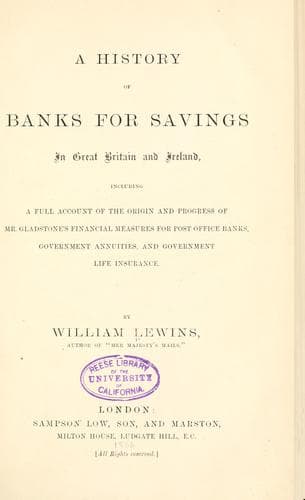
A History of Banks for Savings in Great Britain and IrelandLewins, William
History
A History of Banks for Savings in Great Britain and Ireland
Lewins, William
Postal savings banks -- Great Britain; Savings banks -- Great Britain
Granting that Savings Bank clerks may be subdued after Mr. Craig's or
some other fashion, it would still appear that the indispensable
requisites to a complete uniformity of accounts must be something like
uniformity in the distinctive principles and practices of Savings
Banks. We refer to such matters as the limitation in the amount of
deposits, the rate of interest, notices of withdrawal, &c. The
question of the limit of deposits was discussed before the Committee.
_Mr. Meikle_ and _Mr. Sturrock_ objected to any alteration in the
limit of deposits which for many years had stood at 30_l._ for any one
year, and 150_l._ in all. _Mr. Boodle_ thought the annual limit should
be increased to 50_l._, and the total deposits to 250_l._ _Mr. Finney_
wished it to be at 50_l._ and 200_l._ respectively. _Mr. Saintsbury_
and _Mr. Maitland_ agreed with Mr. Boodle, provided the rate of
interest were reduced, and there were ready access to the public
funds. Then as to the rate of interest itself, _Mr. Maitland_ said
that the highest rate of interest that can safely be offered should be
given for small savings, "though," he said, "_lowering_ the rate would
bring Savings Banks back more to what they were intended to be." He
also thought the rate should vary according to the market rate of
interest. _Mr. Boodle_ objected to a fluctuating rate. _Mr. Meikle_
was of opinion that a fixed rate of three per cent. should be given.
_Mr. Craig_ said a rate of 2_l._ 17_s._ or 2_l._ 18_s._ was
satisfactory to depositors. _Mr. Wortley_ thought three per cent. a
fair rate of interest. _Mr. C. W. Sikes_ suggested that the interest
to depositors should be three per cent. on sums up to 100_l._, and two
per cent. over that sum. He thought a low rate of interest would not
deter the working man from Savings Banks. If we turn from this
theorizing to what was the practice of different Savings Banks in this
and other particulars, we shall find diversities of operation which
not only account for so much difference of opinion, but which rendered
unanimity of action almost impossible. It was then, and is still, a
very popular notion, that the Savings Banks proper pay a uniform rate
of interest of three per cent. per annum; nothing can be more
mistaken. When the enactment was passed establishing the still
existing rate, it was generally considered in Parliament that five
shillings per cent. was ample enough to pay all expenses of
management; but the fact is, double that amount has not sufficed in
some cases. In 1857 there were, according to a Parliamentary Return,
no less than thirty-two different rates of interest paid by Savings
Banks managers, and had the Return embraced a much more recent period
the same diversity would have been shown. Thus, in that year--
Public-domain text, read in full here on John Shaqi.
Reviews
Reviews
No reviews yet
Be the first to share your thoughts on this work.
Elsewhere in the archive
Join the Discussion
Join the discussion
Sign in to leave a comment or review.
Sign InorCreate an account