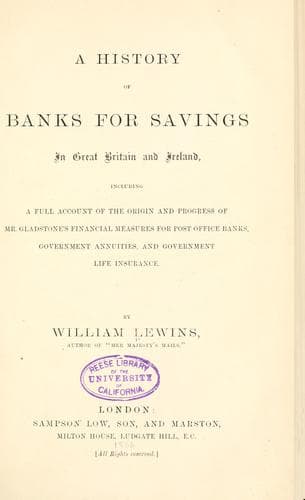
A History of Banks for Savings in Great Britain and IrelandLewins, William
History
A History of Banks for Savings in Great Britain and Ireland
Lewins, William
Postal savings banks -- Great Britain; Savings banks -- Great Britain
For reasons which we have adduced at great length in the last chapter,
the feeling grew that a sweeping change would require to be made in
the institution of Savings Banks. Supplementary banks of different
kinds were established, and they met in great part the object for
which they were designed; meanwhile, the great majority of Savings
Banks took no steps to provide more conveniences for the public, or
they were powerless to effect them.[152] When reasonable changes were
resisted between 1850 and 1860, it occurred to several that agencies
might be contrived to do the same work after a different fashion, and
that this project should be carried out, even were the ultimate result
to diminish the usefulness of most of the older banks, or gradually to
set them aside. It is to proposals having the former object in view
that we must now turn.
It is not a little curious that long before Savings Banks were
legalized by Act of Parliament, and even before Dr. Duncan began his
earnest and self-denying efforts to establish them on a safe footing,
at least two different efforts were made to promote the growth of
provident habits by a system of Savings Banks which should extend
throughout the entire country. We refer to Jeremy Bentham's scheme of
"Frugality Banks," and Mr. Whitbread's "Poor Fund and Assurance
Office."
The plan of the former is detailed in Bentham's works; the latter
scheme, partly described in an earlier portion of this volume (pages
23-4) was submitted to Parliament in 1807, and a bill,--a full
Abstract of which will be found in the _Appendix_,--founded upon it,
actually passed the House in some of its earlier stages. Some of the
provisions of this bill were admirable; and some, owing to the state
of the Post Office of that time, would not have been so easily worked
through that department as was intended. As it was, the country
preferred the class of banks just then rising into notice; and in 1817
the Legislature forgetting Mr. Whitbread's scheme, gave its sanction
and countenance to the banks which had been established on purely
benevolent principles, and which were totally independent of each
other. In the course of years, that system having been tried in every
possible way without producing the safety and convenience so much
desired in institutions of this sort, the principle of a uniform plan
of banks in connexion with the Post Office advocated by Mr. Whitbread
again came up, the story of the proposals for and the introduction of
which we are about to tell.
Public-domain text, read in full here on John Shaqi.
Reviews
Reviews
No reviews yet
Be the first to share your thoughts on this work.
Elsewhere in the archive
Join the Discussion
Join the discussion
Sign in to leave a comment or review.
Sign InorCreate an account