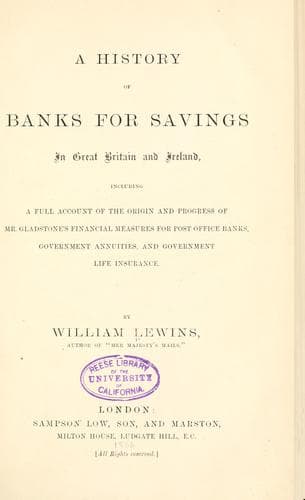
A History of Banks for Savings in Great Britain and IrelandLewins, William
History
A History of Banks for Savings in Great Britain and Ireland
Lewins, William
Postal savings banks -- Great Britain; Savings banks -- Great Britain
The bill was introduced into Committee on the 8th of April, 1861,[172]
where trifling alterations were made in several of its clauses. _Mr.
Slaney_, who had paid great attention to subjects of this nature,
hoped that the deposits would not be restrained, as under the old
system, he thought no limit should be placed upon the providence of
the labouring classes. _Mr. Vance_, an Irish member, alluded, as he
did on subsequent occasions, to what he considered the centralizing
tendencies of the scheme. He thought Dublin ought to be the centre of
operations for Ireland as under the Money Order system. The principal
opponent of the measure on this occasion was _Mr. Ayrton_, the member
for the Tower Hamlets, who in some quarters has been credited with the
advocacy of the scheme before this period. In a long speech, Mr.
Ayrton took exception to most of the details of the measure as they
were now proposed, and to the principles of the measure as a whole.
Mr. Ayrton held that data enough had not been presented to enable
members to form an opinion as to whether the scheme would pay or not.
"It was all very well to talk of subjects being self-sustaining, and
even economical, but under such statements our expenses had gone on
continually increasing." He adduced at length the case of the County
Courts bill, and the Government Superannuation Allowances bill, which
he said were introduced and passed under some such pretences. It would
be the same with the Savings Banks; the Government would never be able
to keep to the two and a half per cent., but would have to be guided
by the rate allowed to other bankers. "The scheme of a national bank,"
continued the honourable member, "_however plausible_ it might look at
the outset, would lead to the most serious consequences." The
Committee which sat on the subject, and of which he, the speaker, was
a member, came to the decided and unanimous conclusion that it was
desirable to separate the operation of banking for the people from the
National Treasury. It was thought that these national banks would act
as a powerful inducement to the working men to entrust their money to
the Government rather than to their own Benefit Societies, which were
regarded as too much associated with Trade Societies. In his opinion
Benefit Societies and Trade Societies had been the means of
regenerating the people, and were eminently conservative; and it was
not expedient to discourage these societies by means of the proposed
banks. Nor was this all. It was desirable that the country gentlemen
should take an interest in the welfare of the working people
surrounding them; and to supersede their exertions by mere
stipendiaries of the State would weaken that social system on which
the liberties of the people were mainly founded. _Mr. Alderman
Sidney_, "as one conversant with figures," ventured to say, that if
the scheme were carried out, our national establishment must be
greatly augmented; and if it proved successful, "the establishment
Public-domain text, read in full here on John Shaqi.
Reviews
Reviews
No reviews yet
Be the first to share your thoughts on this work.
Elsewhere in the archive
Join the Discussion
Join the discussion
Sign in to leave a comment or review.
Sign InorCreate an account