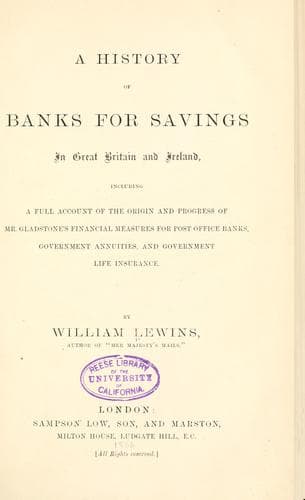
A History of Banks for Savings in Great Britain and IrelandLewins, William
History
A History of Banks for Savings in Great Britain and Ireland
Lewins, William
Postal savings banks -- Great Britain; Savings banks -- Great Britain
The best possible test, not only of the influence of the new banks,
but of their marked superiority and adaptability to the wants of the
country, is found in the fact, that since 1861, no Savings Bank on the
old principle has been established. If it be not desirable to
establish new banks, it cannot be a matter of much concern to the
country how soon the _bulk_ of the existing banks on that principle
give up their charitable business. We say bulk advisedly, for many of
these banks do not partake, in the ordinary sense of the word, of the
character of charitable institutions. From a careful and impartial
view of the whole subject, it seems to us, that no measure short of
the abolition of the Post Office Banks can keep alive those of the old
Savings Banks which cannot compete with the former in the quality and
the amount of their accommodation. On the other hand, no one who has
at heart the interests of those classes which Savings Banks seek to
benefit would wish to see the existence of any institution shortened,
which, while profitably ministering to a great public want, is neither
subsidized by the State, nor conducted so as to leave an impression on
the depositor's mind that it is charitably ministering to his
necessities. Those which cannot give the necessary facilities, must
succumb sooner or later; those which answer to the latter
requirements, may still have a long course of honour and usefulness
before them. Before 1861, there might be no option or alternative to
the existing order of things; the institution of Post Office Banks has
supplied both.
Twelve months after the organization of the Post Office Banks the
trustees of thirty-five of the old Savings Banks had closed their
banks. Up to the present period (March, 1866), sixty additional banks
have followed the example thus set them; this making a total
of--exclusive of Penny Banks--ninety-five banks which have transferred
their business to the Post Office. The least important of these
institutions was that of Dumbarton, established in 1846, and which had
but 83_l._ of capital. The most important bank on the list is
Birmingham, originally established in 1827, and which had, on the 20th
of November preceding the date of closing, a capital of 583,461_l._
The fact of the Birmingham Savings Bank coming over, formed the one
necessary assurance that the new system had obtained, not only the
confidence of the country, but the tacit acquiescence of those who
managed large businesses of the same nature. It was very properly
argued at the time, that if a majority of such trustees as those of
Birmingham could come to the conclusion to hand over their
well-managed and flourishing bank to the Government, any bank might do
so.[182]
The following Return, which has been carefully compiled, is of
sufficient interest and importance to occupy the prominent place we
assign it.[183]
Public-domain text, read in full here on John Shaqi.
Reviews
Reviews
No reviews yet
Be the first to share your thoughts on this work.
Elsewhere in the archive
Join the Discussion
Join the discussion
Sign in to leave a comment or review.
Sign InorCreate an account