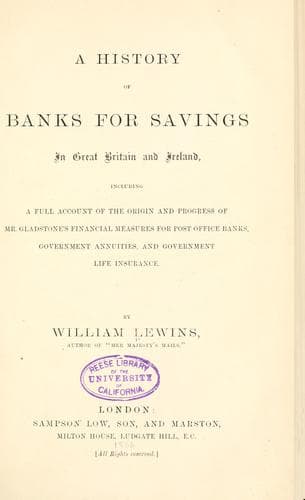
A History of Banks for Savings in Great Britain and IrelandLewins, William
History
A History of Banks for Savings in Great Britain and Ireland
Lewins, William
Postal savings banks -- Great Britain; Savings banks -- Great Britain
On the 4th of March, Mr. Gladstone moved the committal of the bill.
Mr. Turner, Mr. Powell, Mr. T. Hankey, Sir Minto Farquhar, and several
other members, protested against going on with the bill without an
opportunity for full discussion, and most of them expressing great
dissatisfaction with the Government proposals relating to Life
Insurance, the Chancellor endeavoured to separate the bill into two
parts, to pass that having reference to Annuities, and to defer the
consideration of the clauses relating to Insurances to a subsequent
period. The debate was adjourned.
Three days afterwards Mr. Gladstone made a long and elaborate speech
in defence of his proposals, and addressed himself with great
earnestness and power to the task of disabusing the public mind of the
many erroneous impressions which within a very short time had taken
possession of it. The history of his proposals was a short and simple
one. In the autumn of the previous year the Registrar of Friendly
Societies, in his Report for 1862, had recorded an unusual number of
very gross abuses and violations of trust on the part of those
Societies. The Report was in fact full of a multitude of complaints
from persons in all parts of the country, who called for redress. So
important had the facts been regarded that at least two important
journals[198] had published several articles calling attention to the
scandalous condition of these institutions. It had been suggested to
him (Mr. Gladstone) that the subject of small life assurances, having
already received in principle the sanction of Parliament, ought, under
these circumstances, and the fact of an excellent machinery in
connexion with the Post Office being ready for use, to be again
considered by the Government. He agreed with this view of the case,
and had now proposed to take action upon it. It is almost impossible
to give an account in detail of the speech which followed; next to the
Budget speech, it was the longest which Mr. Gladstone made in the
session of 1864. We can, however, and ought to describe its principal
points. Mr. Gladstone observed that no one considered Savings Banks,
Annuities, or Insurances to be, abstractedly, matters desirable for
the Government to deal with. But the Post Office Savings Banks which
that House had legalized, though interfering distinctly with other
interests, had produced great and lasting results; so likewise had the
Factory Acts, though they likewise had greatly interfered with the
liberty of private action. This bill, however, prohibited nothing
whatever. "I do not deny that it is Government interference, or that
it requires justification or apology; but I do deny that we are to be
frightened and terrified by clamours respecting centralization, or
respecting undue assumptions of power by the Executive." "All that is
requisite in such a case is to show that what the Government proposes
it can do safely, and likewise that what it proposes it can do
Public-domain text, read in full here on John Shaqi.
Reviews
Reviews
No reviews yet
Be the first to share your thoughts on this work.
Elsewhere in the archive
Join the Discussion
Join the discussion
Sign in to leave a comment or review.
Sign InorCreate an account