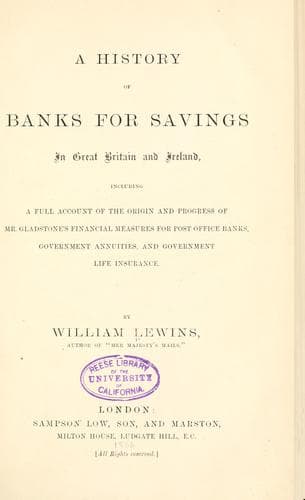
A History of Banks for Savings in Great Britain and IrelandLewins, William
History
A History of Banks for Savings in Great Britain and Ireland
Lewins, William
Postal savings banks -- Great Britain; Savings banks -- Great Britain
The bill as amended by the Committee was passed on the 20th of June.
On this occasion many of its members described the benefit which the
bill had received from the inquiry, and none now complained of the
limited nature of that inquiry. It originally consisted of three
clauses; it came out with seventeen, sixteen of which were new. It
provided that no policy of Life Assurance should be granted for more
than 100_l._; and, not to interfere unnecessarily with Friendly
Societies, that none should be granted for less than 20_l._ _Mr.
Estcourt_, especially, warmly espoused the measure. "No one now more
desired to see it passed than he did. If a master or employer wished
to make a provision by way of annuity for a faithful servant in his
old age, he could do so with perfect security under the bill." He also
thought, "that if the working classes of this country did not derive
great advantage from the measure, it would be their own fault." _Sir
M. Farquhar_ was equally hearty in his praise of the scheme, and
speaking of Mr. Gladstone said, "The country had every reason to thank
him." Mr. Gladstone observed, that it was a matter of great
satisfaction to him that as the bill entered the House in peace and
quietness, so it was likely to quit it with general expressions of
good will.
The bill was carried through the Lords under the charge of Lord
Stanley of Alderley, and, passing through its several stages without
discussion, received the Royal Assent July 14, 1864, and arrangements
were ordered to be made to carry its various clauses into practical
operation.
During the long recess the Tables were prepared under the eye of the
Commissioners for the Reduction of the National Debt; and, working in
harmony with the Commissioners and with a common purpose, the Post
Office authorities at the same time arranged the Regulations under
which, and the organization by means of which, the whole of the plans
should be carried out. The Regulations themselves were, we understand,
arranged under the immediate superintendence of Mr. Scudamore, one of
the two gentlemen who organized the Post Office Banks; the machinery
chosen for the purpose was that of the Receiver and Accountant-General's
department. At the commencement of the session of 1865 both the Tables
and the Regulations were laid before Parliament and received the
proper sanction. The Tables, like all ordinary Insurance Tables, show
the various kinds of benefit which Government can now offer to the
community, and the price at which these benefits may be purchased. The
Regulations, on the other hand, describe the means to be used to
obtain these benefits, and give in full the conditions under which any
kind of purchase may be made.[202]
Public-domain text, read in full here on John Shaqi.
Reviews
Reviews
No reviews yet
Be the first to share your thoughts on this work.
Elsewhere in the archive
Join the Discussion
Join the discussion
Sign in to leave a comment or review.
Sign InorCreate an account