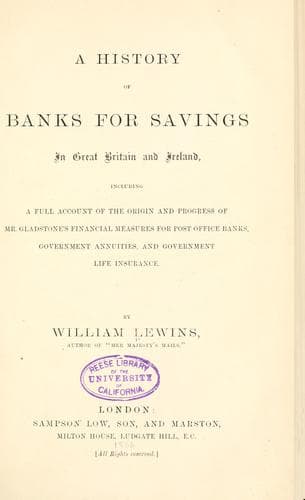
A History of Banks for Savings in Great Britain and IrelandLewins, William
History
A History of Banks for Savings in Great Britain and Ireland
Lewins, William
Postal savings banks -- Great Britain; Savings banks -- Great Britain
It is now perfectly easy for any of the other Government departments,
for railway companies, merchants, manufacturers, and other large
employers of labour, to make arrangements under the 32d clause of the
Regulations, to do for their workmen (and we are at a loss to
understand why this has not been done before) what the Post Office
authorities have done for their servants. The clause to which we have
alluded provides, that if boards of management or masters of workmen
will undertake to collect the sums by means of deductions from the
wages of their officers or servants, with a view to paying the
premiums over to the officers of the Postmaster-General, then the
latter shall, "if he think fit, make arrangements with the said
employers for such purpose, and shall constitute the departments,
offices, or places of business of such employers, offices for the
receipt of proposals, and for the receipt of premiums and instalments;
and shall pay to such employers such remuneration for the work done by
them, or their officers or servants, as shall be agreed upon between
him and them."
Surely, with all such facilities, and with such inducements to the
workman to make provision for those who are nearest and dearest to
him,--this provision to be payable at once, on the security of the
nation, when he is no longer able to contribute to their
support,--little persuasion should be needed to make him do that which
is now one of the first duties of a man who has a wife or family
dependent upon his exertions. It is only too true that workmen and the
less educated portions of the lower middle classes may be blinded and
cajoled into believing that those institutions will serve their
interests best which, depending upon all kinds of meretricious
attractions, promise immediate benefits for little payment, but only
end in disappointing, if not in swindling them. It seems to us,
however, that those who, like the majority of large employers, have
both the capacity and the opportunity for directing these classes
aright, are not only warranted, but, in all fairness, are expected to
attempt to do so.
Public-domain text, read in full here on John Shaqi.
Reviews
Reviews
No reviews yet
Be the first to share your thoughts on this work.
Elsewhere in the archive
Join the Discussion
Join the discussion
Sign in to leave a comment or review.
Sign InorCreate an account