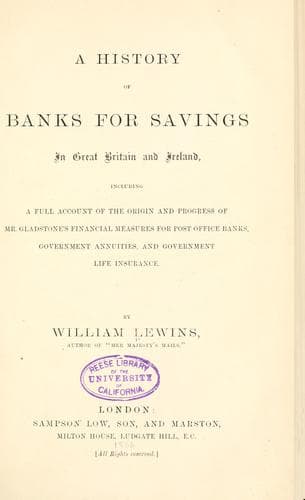
A History of Banks for Savings in Great Britain and IrelandLewins, William
History
A History of Banks for Savings in Great Britain and Ireland
Lewins, William
Postal savings banks -- Great Britain; Savings banks -- Great Britain
She continued to deposit the Savings from her wages £ s. d.
from that time to the 21st of July, 1828, amounting to 119 11 0
Interest accruing from 1818 to 1828 30 9 0
---------
150 0 0
=========
This sum of £150 being allowed to accumulate by interest
until 1836 became 200 0 0
---------
From 1836 interest on this sum had to be withdrawn
half-yearly, which from 1836 to 1863 amounted to 160 9 8
---------
Esther Sykes died March, 1863, aged 78, and her
executors received from the Bank the sum of 200 0 0
=========
Thus in this interesting case the cash deposited at different times
amounted to 119_l._ and the total amount of interest on that sum was
240_l._, of which 160_l._ was paid to the depositor herself during her
lifetime, and 200_l._ to her executors. It is not a little curious,
nor is it surprising, that five of the relatives and legatees of this
Esther Sykes should have gone to the Huddersfield Savings Bank to
deposit the money left to them.
Of the other promising provident measures adapted to the requirements
of the industrious classes, the most important, but at the same time a
somewhat hazardous one, is that of co-operative societies. These
societies, though beset with difficulties, are doing a good work in
many localities. The stronghold of the system, be it remembered, is in
a town where, owing to the cupidity of the manager of the Savings
Bank, the savings of years were swallowed up, and, in consequence,
habits of accumulation in this form were rooted out from among the
people. The co-operative principle can be directly traced to the
wide-spread distrust created by this gigantic and far-reaching fraud.
It remains now to be seen whether a higher intelligence and a greater
power of self-government than is generally found in large associations
of working men will not be indispensable to the progress of these
societies. Personally, we have little hesitation in affirming that the
real progress of these classes will be safer, and not only safer but
quicker, if the bulk of them will leave combined enterprises of this
nature to those of their fellows who have already saved money enough
to enable them not only to enter into such business, but to lose in
the venture. Once a man has run up an account in any of the people's
banks--whether the old or the new banks does not make much
difference--he might, and perhaps ought to risk a proportion in such
societies, which, where properly and prudently managed, are very
beneficial to all connected with them.[209]
Public-domain text, read in full here on John Shaqi.
Reviews
Reviews
No reviews yet
Be the first to share your thoughts on this work.
Elsewhere in the archive
Join the Discussion
Join the discussion
Sign in to leave a comment or review.
Sign InorCreate an account