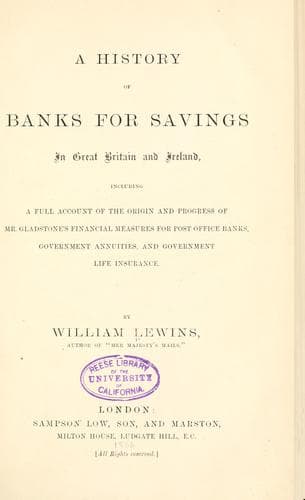
A History of Banks for Savings in Great Britain and IrelandLewins, William
History
A History of Banks for Savings in Great Britain and Ireland
Lewins, William
Postal savings banks -- Great Britain; Savings banks -- Great Britain
left destitute of other support than parish pay, or a home in the
workhouse. Baron Mazeres, so early as 1773, who published a work on
Annuities, succeeded in getting a bill introduced and passed through
the House of Commons--though unfortunately it was lost in the House of
Lords--which would have made the legislation of 1833 less necessary.
_Lord Althorp_ now stated that the object he had in view was simply
and solely to benefit the working classes. The lowest sum which could
be granted as a Government Annuity was 30_l._ a-year. He would propose
to make the sum 20_l._ The annuity should not be assignable, or
transferable, except in cases of bankruptcy or insolvency; and in the
case of the purchaser, either through necessity or choice making
default in the annual payments, or dying before the annuity commenced,
the whole of the money subscribed should be paid to him or his
executors. The tables would be calculated at the rate of 3_l._ 15_s._
per cent. and this rate being less than the ordinary Savings Bank
rate, would enable the Government to introduce the clause for
returning deposits. To no class, it was thought, would these proposals
be of more service than to members of Benefit Societies, who would
thus be enabled to secure superannuation on Government security, and
confine the objects of the society in which they might be members to
relief in cases of sickness or death. Lord Althorp calculated that a
person at the age of twenty-five, paying six shillings a month as a
deposit into the Savings Bank, would be entitled at the age of sixty
to an annuity of 20_l._ a-year. He contended, that, from the
calculations which had been made, Government could not lose by these
arrangements, and he thought the principal feature of deferred
annuities for a small amount, with money returnable in the cases above
stated, might be made,--if the working classes would only avail
themselves of the measure,--to tend greatly to their worldly comfort
and advantage. _Mr. Thomas Attwood_, the member for Birmingham, who
made some remarkable speeches in the House on matters of finance, but
especially with regard to Savings Banks, objected not only to this
proposal, but to legislation of any sort with regard to them. The
money deposited in Savings Banks might as well be put into the country
banks, for the average amount of each deposit, he was sure, was over
10_l._ and 10_l._ was the minimum sum which country banks would take.
He "did not believe in paying so much to keep up such establishments,
especially when they were not wanted." To such lengths will
intelligent men go, and to such an extent will they shut their eyes!
Mr. Attwood put his views before the House quite mildly in this
instance, as compared with subsequent speeches. _Mr. Brotherton_, a
member greatly respected in the House, who had once belonged to the
ranks of the people, and who might therefore be supposed better to
understand their requirements, felt sure that Savings Banks had been
Public-domain text, read in full here on John Shaqi.
Reviews
Reviews
No reviews yet
Be the first to share your thoughts on this work.
Join the Discussion
Join the discussion
Sign in to leave a comment or review.
Sign InorCreate an account