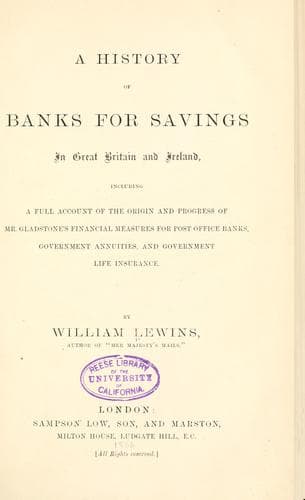
A History of Banks for Savings in Great Britain and IrelandLewins, William
History
A History of Banks for Savings in Great Britain and Ireland
Lewins, William
Postal savings banks -- Great Britain; Savings banks -- Great Britain
productive of great national good, and could not be too numerous. _Mr.
Pease_, the Quaker member for South Durham, hoped that nothing would
be done to induce the working classes to try country banks in
preference to Savings Banks. In his own county 700,000_l._ or
800,000_l._ had been lost in country banks, and therefore it would be
highly dangerous to advise the poor to lodge their money there. Mr.
Pease's position, as a large employer of labour, gave his remarks
weight, when he trusted that the clause in the bill of 1828, which
provided that Accounts of Savings Banks should annually be laid before
the Government, would be carried out in its entirety; "there was
little hope of Savings Banks turning out uniformly profitable to the
industrious classes, except Government maintained a strict
superintending control over them." The Chancellor of the Exchequer
said this was done, and in two or three instances since he took
office, where the Trustees had neglected to furnish proper returns,
the Commissioners had exercised the power which the law gave them,
_and had closed the banks_ till the Accounts were sent up.[40] In May
the bill was carried through Parliament unaltered, but, as usual,
opposed by two or three fractious members. Mr. Thomas Attwood again
expressed his disapprobation of Savings Banks; and we allude to his
speech with a view solely of enlivening our pages, which may over this
ground of legislative enactments be dull to some readers. This
gentleman stated his belief on the third reading of the Savings Bank
Annuities Bill, that Savings Banks "were instituted by the late Lord
Liverpool and his Government, not for the good of the people, but for
three different purposes." The first was to draw capital to London, in
order to bolster up the Funds; the second was to give the Government
the power of putting their hands into the pockets of the people; and
the third, to enable them to scourge the people.[41] On the House
showing manifest signs of disapprobation, Mr. Attwood said, "Hon.
members might express disapprobation as much as they pleased, and the
noble lord (Althorp) might laugh, but he firmly believed that Lord
Liverpool's great object in getting up these banks was to get his claw
in the people." _Lord Althorp_ replied with the straightforward
understanding, and quiet, manly good sense which always characterized
this eminent statesman. He wondered that Mr. Attwood had not imputed
to Government another motive, that being, to realize _profit_ by
Savings Banks, which he need not say they had scarcely yet done. He
might have smiled, but it was entirely on account of the originality
of the hon. member's ideas on the subject: seriously, it was
astonishing that such arguments should be used by reasoning men. "So
far from being an injury to the people, he believed these banks
conferred on them the greatest advantages; and so far from affording
the Government the means of trampling upon them, they would have an
Public-domain text, read in full here on John Shaqi.
Reviews
Reviews
No reviews yet
Be the first to share your thoughts on this work.
Join the Discussion
Join the discussion
Sign in to leave a comment or review.
Sign InorCreate an account