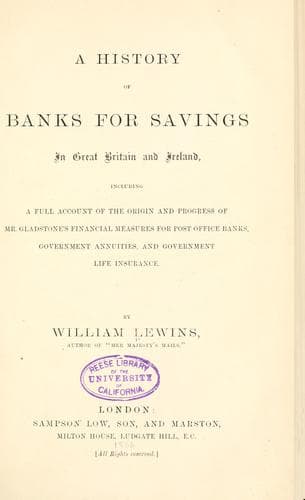
A History of Banks for Savings in Great Britain and IrelandLewins, William
History
A History of Banks for Savings in Great Britain and Ireland
Lewins, William
Postal savings banks -- Great Britain; Savings banks -- Great Britain
of the morning, so have education and a free press opened the eyes of
the people to their true interests, and shown them which class of men
have most wished for and best worked to promote these interests.
It was not, however, only by such men as Cobbett that Savings Banks
were misinterpreted and misrepresented. Like every other new and
untried measure, it had to run the gauntlet of an educated as well as
an ignorant opposition. It was a very usual thing to find the
discussion on the utility of Savings Banks waxing warm in the most
important organs of public opinion. For example, the _Times_ newspaper
early took a decided stand against Savings Banks, and tried to
maintain its position, as we shall see more fully subsequently, long
after the country had given them a pretty unanimous verdict of
approval. Just after the period of which we are speaking, a
correspondent in the then, as now, leading journal, thought himself
able to trace in Savings Banks, "a great source of mischief; and that
to them,"--though in what manner it is not attempted to be
proved,--"may be attributed a considerable portion of the distress
which has been so long felt, and which does not appear to diminish in
most of the manufacturing districts." "God forbid," ejaculates this
remarkable genius, "that I should desire to encourage improvidence
amongst any portion of society; but there is a wide distinction
between parsimony and extravagance, and these banks have literally
made misers, and held out a bonus for them to become so." But even
this is not all: the same spirit, says our authority, which actuates a
man in becoming a miser, will operate to prevent their making use of
their petty accumulations. "With the habit of parsimony the mind
becomes degraded, and the workhouse or an application to the
dispensers of parochial relief lose their horrors." It is almost
useless, seeing that now few could be found to advocate such views, to
reply to them. They are based on the assumption, which we take to be
utterly erroneous, that a poor man is less at liberty to lay out his
mite at interest than his richer neighbour; or that if he did so, the
step was more likely to lead to his becoming a miser than his
wealthier neighbour who had all his money in the funds. It is less
necessary to argue the point, inasmuch as the aim of this nonsense is
made quite apparent by the writer concluding with an elaborate
eulogium on Benefit Societies for working men. "They could there,
provide," says he, "at a very trifling expense, against sickness, want
of employment, and numerous other casualties; while, on the other
hand, there would be no need to deprive themselves of the common
necessaries of life in order to add to their hoard." But here again
the fallacy of the argument is clearly apparent. The allowance from a
Benefit Society, then as now, in case of sickness or distress, would
be, generally speaking, quite inadequate to the circumstances
Public-domain text, read in full here on John Shaqi.
Reviews
Reviews
No reviews yet
Be the first to share your thoughts on this work.
Elsewhere in the archive
Join the Discussion
Join the discussion
Sign in to leave a comment or review.
Sign InorCreate an account