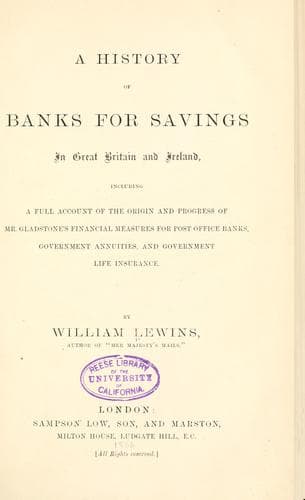
A History of Banks for Savings in Great Britain and IrelandLewins, William
History
A History of Banks for Savings in Great Britain and Ireland
Lewins, William
Postal savings banks -- Great Britain; Savings banks -- Great Britain
requiring it; and how could it possibly be more likely that a person
in this situation would be more independent of parochial relief than
one who had a fund of his own to look to, or perhaps a livelihood at
his command. Such warfare as this went on uninterruptedly for several
years; the advocates of Benefit Societies running down Savings Banks,
and _vice versá_, not in all cases seeing that the two might exist
together, and that each was well calculated to supply a want which the
one or the other class of institutions did not meet. There can be no
doubt, however, which institution suffered most from these
discussions. The most decisive proof of the improvement which was seen
in the condition and the habits of the labouring classes during the
first quarter of the century was the progress of Benefit Societies
from 1802 to 1820. In the former year there were 9,622 of these
societies; in the latter year there were nearly five times that
number. The people during this period had not improved in comforts and
conveniences as they did subsequently; they progressed in the more
skilful use of the same, or even diminished means. These societies
made a deep impression upon the population, and in the same proportion
the people were recovered from the control of their appetites and
passions, and from that propensity to use without restraint those
means of immediate gratification which distinguishes all ignorant
people of whatever rank. Notwithstanding all this, the Friendly
Societies were beset with difficulties, and in the discussions to
which we have alluded their opponents made the most of them. Perhaps
the well-meaning might better have assisted the poor in instructing
them how to reform the management of these societies, and by showing
them the principles upon which they could be most safely established.
However it was, there can be no question that, either from their
inherent defects or the comparison of the benefits to be derived from
the one as against the other institution, Savings Banks soon took the
place of Benefit Societies in the public estimation, and progressed
when, comparatively speaking, the latter declined. In the evidence
given by Mr. Lloyd, the founder of the Hertford "Sunday Bank," before
the committee on the Poor Law previously referred to, he assigned as
one of the causes which had promoted the success of Savings Banks the
evils arising from Benefit Clubs or Friendly Societies, as then
constituted. "There is always," he said, "a regulation, that when
two-thirds of the members choose to assemble and agree to break up the
club, they can; the consequence is, that the other one-third, the old
members, who ought to be deriving an assistance during the last period
of their lives from these clubs, are deprived of it." He had known six
clubs which had been broken up in this way. The following extract from
a report of a committee which was appointed to investigate the rival
claims of Benefit Societies and Savings Banks so admirably sums up the
Public-domain text, read in full here on John Shaqi.
Reviews
Reviews
No reviews yet
Be the first to share your thoughts on this work.
Elsewhere in the archive
Join the Discussion
Join the discussion
Sign in to leave a comment or review.
Sign InorCreate an account