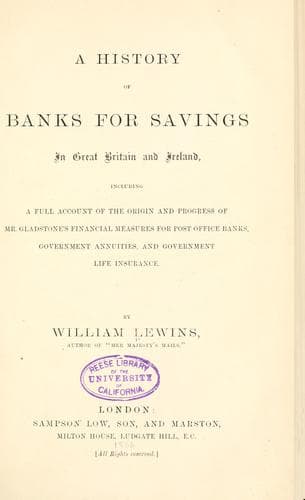
A History of Banks for Savings in Great Britain and IrelandLewins, William
History
A History of Banks for Savings in Great Britain and Ireland
Lewins, William
Postal savings banks -- Great Britain; Savings banks -- Great Britain
whole argument, and says so much with reference to both institutions
which is no less true now than then, that we feel confident our
readers will not object to have it reproduced here.[47] "Benefit
Societies have done much good; but they are attended with some
disadvantages. In particular, the frequent meetings of the members
occasion the loss of much time, and frequently of a good deal of money
spent in entertainments.[48] The stated payments must be regularly
made; otherwise, after a certain time, the member loses the benefit of
all that he has formerly paid. Nothing more than the stated payments
can be made, however easily the member might be able at the moment to
add a little to his store. Frequently the value of the chances on
which the societies are formed, is ill calculated; in which case,
either the contributors do not receive an equivalent for their
payments, or too large an allowance is given at first, which brings on
the bankruptcy of the institution. Frequently the sums are embezzled
by artful men, who, by imposing on the inexperience of the members,
get themselves elected into offices of trust. The benefit is distant
and contingent; each member not having benefit from his contributions
in every case, but only in the case of his falling into the situations
of distress provided for by the society. And the whole concern is so
complicated, that many have hesitation in embarking in it their
hard-earned savings. With such disadvantages who would not rather
choose the simple, secure mode of investment offered by the bank--free
(as the banks were at that time) from them all? But if they must have
the Benefit Society, with its contingent and distant benefits, working
men should not rest here. Thousands of the working classes could well
afford to pay their weekly sums to secure their sick and burial money,
and yet have enough to spare to provide against the other rainy days
of their life. A poor man's savings are continually liable, while in
his own custody, not simply to professional thieves, but also--and
there is far more danger of it--to be pilfered by himself and his
family. They are often lost by being intrusted to improper hands; they
are still oftener worse than lost in the ale-house or the gin-palace,
and the money which properly taken care of might give the means for
occasional enjoyments of a harmless kind, providing for the legitimate
wants of his children, or which might support all during the
intermissions of employment to which all are exposed, may be worse
than squandered."
Public-domain text, read in full here on John Shaqi.
Reviews
Reviews
No reviews yet
Be the first to share your thoughts on this work.
Elsewhere in the archive
Join the Discussion
Join the discussion
Sign in to leave a comment or review.
Sign InorCreate an account