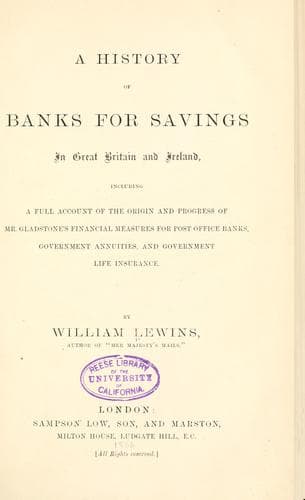
A History of Banks for Savings in Great Britain and IrelandLewins, William
History
A History of Banks for Savings in Great Britain and Ireland
Lewins, William
Postal savings banks -- Great Britain; Savings banks -- Great Britain
It was seen from the commencement of Savings Bank operations that the
first and most imperative element should be complete and
unquestionable security. When Government undertook to legislate for
Savings Banks it did so with a view to their protection from those
frauds which must necessarily overtake some of a great number of
semi-private undertakings. In 1817 the Banks were rapidly increasing
in number and importance, and it was only natural to suppose and
assume that abuses would creep into the management. To meet the
probability of a misapplication of the funds, Government agreed to
take all the money deposited with the trustees of Savings Banks, and
to guarantee a certain fixed rate of interest for it, even above that
which the fund directly obtained for itself. This was at once an
encouragement to the frugal and a perfect security for such sums as
were paid to the National Debt Commissioners. In the interval,
however, between the payment of the sums by the depositors and the
second payment by the trustees, no safeguard was provided beyond the
vigilance of the same voluntary and unpaid trustees. Those trustees
were completely irresponsible after the year 1828. Before that time we
can only assume their responsibility, not from the ordinary reading of
the enactment, but from a decision which was given in a court of law.
That decision was to the effect "that deposits are made by persons,
not on the faith of the person acting as cashier or actuary, but upon
the faith of the gentlemen who act as trustees.... If, therefore, the
clerk or other person employed by them (the trustees) is guilty of
peculation, they are themselves liable for any defalcation which may
ensue." Whether this decision was right in law or not matters little
now, inasmuch as the Act of 1828 released the trustees from any such
obligation entirely, declaring as it did that "no trustee or manager
should be personally liable, except for his own acts or deeds, or for
anything done by him;" and even this was again limited "to cases where
he should be guilty of _wilful neglect or default_." The valueless
character of the safeguards granted to those who of all classes most
needed ample security for that for which they had pinched and
economized soon began to be seen.
Having limited the period of our survey in this chapter to the year
1844, we cannot here introduce the case of the great frauds in Savings
Banks which created such painful sensations all over the country as
one by one the most monstrous iniquities practised on the most
deserving of the poor came to light. Our only reference here will
therefore be to one such case in Ireland, and the first instance of
the kind in England.
Public-domain text, read in full here on John Shaqi.
Reviews
Reviews
No reviews yet
Be the first to share your thoughts on this work.
Elsewhere in the archive
Join the Discussion
Join the discussion
Sign in to leave a comment or review.
Sign InorCreate an account